








.webp)






Help our experts understand you better by filling our 2-Minute Form, to find the right education loan
Get instant loan offer suitable to your profile !

On this Page:
Check your Avanse education loan status the right way. Decode each application stage, spot silent delays, and understand what your portal is not telling you in 2026.

Quick Summary:
| What You Think Is Happening | What Is Actually Happening |
|---|---|
|
Portal shows "Under Review" for 10+ days |
File is likely stuck at credit committee or co-applicant verification, not document check |
|
"Sanctioned" status means money is coming |
Most NBFC sanctions are conditional; disbursement only moves after every "subject to" clause is cleared |
|
Disbursement delay = lender being slow |
Tranche release depends on university fee schedule, FEMA compliance, and FOREX timing |
|
Status portal is the source of truth |
RM updates and credit team notes often contradict the portal display |
|
Quick approval means smooth disbursement |
Some applications get re-evaluated post-sanction if visa, admit, or co-applicant data shifts |
|
3-day sanction promise is universal |
This applies only to specific STEM Master's cases in the US, not most applicants |
According to the Reserve Bank of India's most recent sectoral data, outstanding bank education loans stood at INR 1,23,066 crore as of July 2024, and NBFC education loan assets under management hit roughly INR 64,000 crore by end of FY25 according to Crisil Ratings analysis. Avanse Financial Services is one of the largest specialised education-focused NBFCs in this segment, and the volume it now processes has created an unintended consequence that almost no guide talks about openly: the gap between what the status portal displays and what is actually happening inside the credit file.
If you have applied for an Avanse education loan and are refreshing the portal every few hours, you are not alone. Crisil's FY26 outlook explicitly notes that NBFC disbursements were up only 8 percent in FY25 compared to 50 percent in FY24, with US-bound disbursements falling around 30 percent due to visa appointment shortages and Optional Practical Training policy uncertainty. This slowdown changed underwriting behaviour across all major NBFCs including Avanse. More files are being routed through manual review, more sanctions are being issued with conditions attached, and more disbursements are being released in tighter tranches than before. The portal, however, was built for the older, faster pipeline. So the lag between what you see and what is happening behind the scenes has widened in 2026.
Most Avanse status guides will walk you through where to click on the portal. Almost none of them will tell you that the portal display can lag the underwriting backend by 24 to 48 hours, that a "Sanctioned" status without a cleared conditions list is functionally the same as "Not Sanctioned" for disbursement purposes, or that the Avanse mobile app shows more real-time information than the web portal for tranche releases. These are the gaps where students lose the most time.
This guide is not another walkthrough of where to click. It is about what each status really means, which delays are normal, which ones signal a problem, and what to do when the portal stops moving.


A few years ago, the Avanse loan application status moved almost linearly. Apply, submit documents, get a sanction in 3 to 7 days, receive disbursement in another 7 to 10. That is still the marketing promise on most pages.
The reality on the ground in 2026 is messier. Avanse went live with Scienaptic AI's credit decisioning platform around 2022, which automated parts of the underwriting process. This means simple files now move faster, but borderline files get flagged for human review and can sit longer than expected. Multiple Trustpilot reviewers in the last quarter have flagged the same pattern: smooth approval, then a week or more of silence between sanction and actual fund release.
Several factors have made Avanse education loan application status less predictable:

The portal does not surface any of this. It just shows you a stage. Understanding what the stage actually means is where most students lose time.
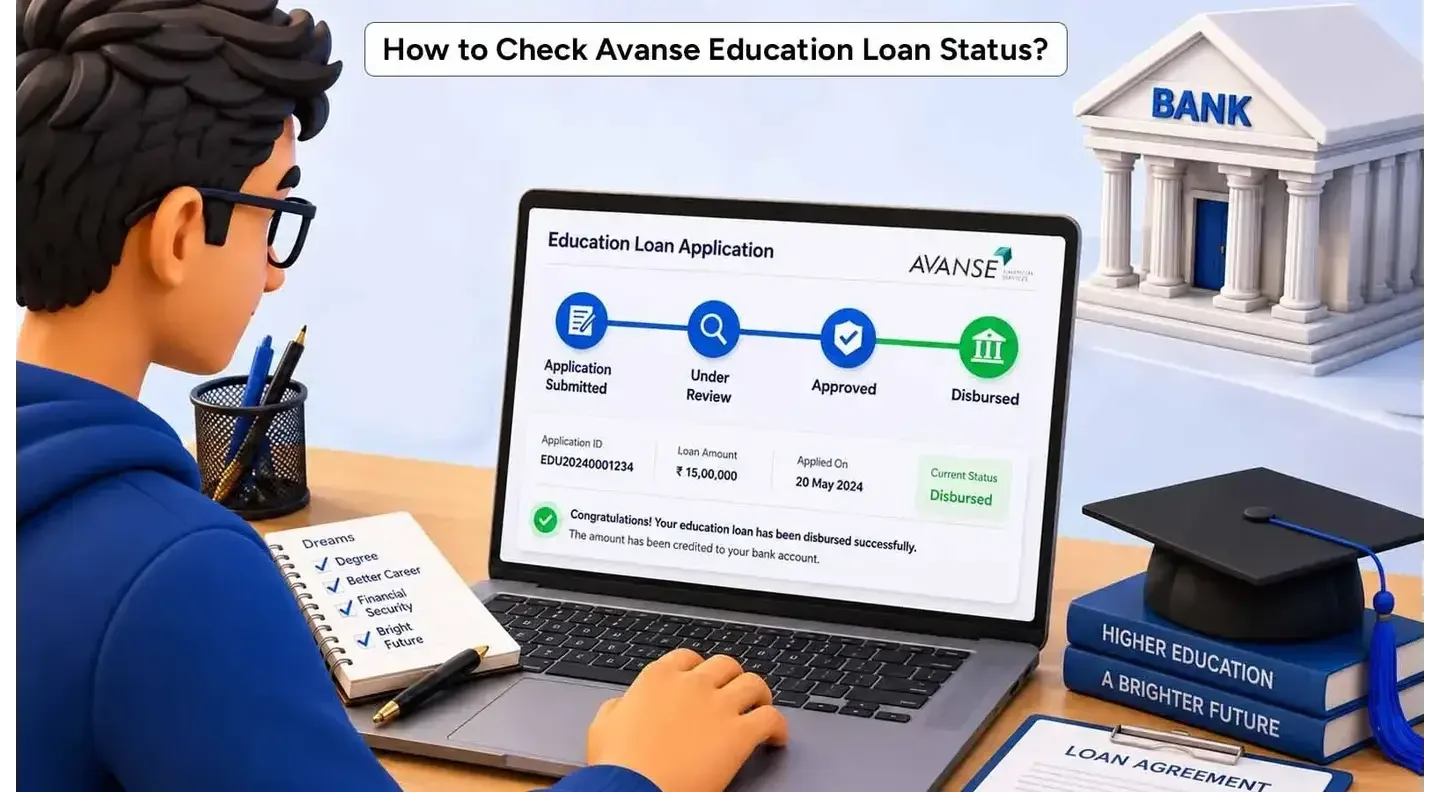
When you use the Avanse education loan login to track your file, you typically see one of five or six high-level statuses. Here is what each one actually means in 2026, based on how Avanse processes files internally.
Application Submitted / Under Review
This is the catch-all stage that students misread the most. It can mean three completely different things:
If your status has been "Under Review" for more than 5 working days without a single query, that is your signal to call the RM directly. A pattern visible on Avanse's Trustpilot page, where the company has over 2,100 reviews, is borrowers describing approval going smoothly but disbursement and post-sanction stages dragging for a week or more. One recent reviewer specifically noted that even after their university confirmed receipt, the next fund release request remained incomplete for over a week, slowing down further admission processes. The portal display did not flag any of this in real time.
Documents Pending / Additional Information Required
This means an underwriter has actively touched your file and raised a query. The clock effectively pauses here until you respond. Common queries in 2026 include:
The trap: students often respond by email to the RM, but the document only gets logged into the system after the RM forwards it to the credit team. There can be a 24 to 48 hour internal lag. Upload directly through the portal where possible.
Sanctioned / In-Principle Approval
This is where most students mentally celebrate. You should not, fully.
A sanction means Avanse has approved the loan in principle, but the Avanse loan statement at this point is conditional. Common conditions tied to sanctions include:
Until each condition is cleared, the Avanse loan disbursement process does not move. This is the single biggest source of "portal looks fine but nothing is happening" frustration. If your sanction letter has the phrase "subject to" anywhere, read every word that follows. That is your actual to-do list.
Disbursement Initiated / In Progress
The portal shows this stage once Avanse has logged a fund release request. But "initiated" is not the same as "received by the university." For tuition fee disbursements, the funds move through the following chain:
Avanse internal release → bank transfer to designated account → FEMA compliance check (for overseas remittance) → SWIFT transfer to university → university accounting team confirms receipt
Each link can take 1 to 3 days. The total elapsed time from "Disbursement Initiated" to the university actually marking your fee as paid can be 5 to 10 working days, sometimes more during quarter-end weeks when banks are stretched.
Disbursed
This stage only confirms that Avanse has released the funds. It does not confirm receipt. If your university has not acknowledged the payment, you still need to chase the SWIFT copy or UTR reference. Avanse provides this on request, but the app does not always surface automatically.
Most generic guides list every possible channel as if they all work equally. They do not. Here is what actually delivers real-time information versus what just gives you stale data.
The Avanse mobile app is now the most reliable channel for tracking the Avanse loan disbursement process, particularly tranche releases. The current version allows users to view all loan information on a single dashboard, request tranche disbursement directly, track outstanding balances, and download account statements and amortisation schedules. If you are mid-disbursement and need to know where a specific tranche is, the app gives you a faster signal than the portal.
The Avanse customer portal is best for downloading documents like the sanction letter, foreclosure statement, or NOC. It is less reliable for real-time application stage updates because the underwriting backend does not always push status changes instantly. Many students see a 24 to 48 hour delay between an internal status change and what the web portal displays.
Your assigned RM has visibility into the underwriting comments that the portal does not show. If your Avanse loan status is stuck or unclear, a direct call to the RM yields more information than 10 portal refreshes. The catch: response time depends on the individual, and quality varies. Trustpilot reviews consistently flag this inconsistency. When you do call, ask three specific questions rather than "what is my status." Ask: "Has any underwriter touched my file in the last 48 hours? Are there any internal queries that have not been shared with me yet? Which specific document or clearance is currently blocking movement?" These three questions force the RM to actually check the system rather than reading you back what the portal already shows.
Useful for written confirmation and dispute trails but slow for status queries. Average response time hovers around 2 to 3 working days, which is too slow if you are trying to track an active application.
Almost never needed in 2026 except for physical document collection on secured loans. Skip unless instructed.
Insight: If you only use one channel to track your application, use the mobile app, not the web portal. The portal is built for documentation. The app is built for live status.
Watch the video to learn further about education loans from Avanse Financial Services
If you have spent any time on Reddit's r/IndianStudentsAbroad or student WhatsApp groups, you have seen this complaint pattern: "My Avanse application status has not changed in 10 days. Should I be worried?"
The answer depends entirely on which stage you are stuck at. Here is what each silent delay actually signals.
This usually means one of three things: your file has been flagged for manual underwriting review (common for borderline credit profiles, lower-tier universities, or unusual income patterns), your co-applicant verification is dragging (especially for self-employed parents), or there is a query that has not reached you. Call the RM. Do not wait.
Avanse sometimes raises queries internally without sending a clear consolidated list to the applicant. Ask for a written list of pending items via email so you have a paper trail. Several students on student finance forums have reported that piecemeal queries (one document asked today, another next week) caused their Avanse education loan application status to drag for 3 weeks unnecessarily.
Read your sanction letter again. The conditions are buried in the fine print and they must be satisfied before disbursement. Most commonly: visa proof, admit confirmation, margin payment, or legal vetting of property documents for secured loans.
This is usually a banking timing issue, not an Avanse problem. Ask for the SWIFT copy or UTR reference and share it directly with your university's accounts team. The lag is often on the receiving end, not the sending side.
One thing worth knowing across all four stuck-status scenarios above: Avanse, like most NBFCs, rarely shows a clean "Rejected" status on the portal. What you usually see instead is prolonged silence, a partial sanction at a much lower amount than applied for, or a sanction attached with conditions that are practically impossible to meet. If your application has been silent for more than 10 working days with no document request and no change in stage, treat that as a soft rejection signal and start a parallel application with another lender. Waiting for the portal to declare a clear no usually means losing 2 to 3 weeks you cannot afford close to the visa or admit deadline.
A real case: what a 4-day sanction actually looks like
One pattern worth contrasting against the stuck-portal cases above: applications that move quickly almost always have one thing in common, which is documentation that arrives pre-validated rather than in pieces.
A recent borrower, Vivek Mishra, applied for an Avanse education loan through GyanDhan and received his sanction letter from Avanse in 4 working days. In his public Google review, he noted that the GyanDhan team helped compare offers across multiple lenders before he went ahead with Avanse, and that queries during the underwriting window were resolved without back-and-forth delays.
What is useful for other applicants reading this is not the testimonial itself but the structural reason it worked: the file went in complete, the co-applicant documentation was vetted before submission, and underwriter queries were turned around the same working day they were raised. This is the difference between a 4-day sanction and a 14-day one. The portal will show "Under Review" in both cases. The actual processing inside is not the same.
If your Avanse loan application status is moving slowly, the question worth asking is not "why is Avanse slow" but "did my file go in clean, and am I responding to queries within the same working day they are raised?"
For unsecured Avanse education loan cases, the disbursement timeline broadly looks like this when everything goes smoothly:
For secured cases, add 7 to 14 days for property document verification, legal opinion, and lien registration before the first tranche moves. Loans against fixed deposits move faster than those against property.
Many students misunderstand the tranche model. The full sanctioned amount is not disbursed at once. It is released in line with the actual fee invoice or accommodation requirement, which means each semester or year requires a fresh disbursement request through the Avanse education loan login or app. If you forget to raise the next tranche request 4 to 6 weeks before your fee due date, you will face an unnecessary scramble.
The Day 0 to Day 8 timeline above assumes a clean file with no surprises. Across files we have observed, fewer than half of unsecured cases hit this ideal timeline. The realistic expectation for most students is 10 to 14 working days from sanction to first tranche, not 5 to 8.
The how to check Avanse loan status question matters less than understanding why your status is stuck. Across the patterns visible in Trustpilot reviews, Quora discussions, and student forums, the most common silent stoppers are:
According to RBI's directive effective December 2023, regulated entities must return original property documents within 30 days of full loan closure or face compensation of INR 5,000 per day of delay. This rule has tightened how Avanse handles property paperwork at the front end as well, because the lender now wants the property file to be clean from the start. This is good for borrowers in the long run but adds a few days to initial disbursement timelines on secured loans.
Looking at the macro shifts that have actually changed how Avanse and other NBFCs underwrite right now:
NBFC education loan AUM grew 48 percent in FY25 to INR 64,000 crore according to Crisil Ratings, but disbursement growth slowed dramatically to 8 percent compared to 50 percent the year before. This means more sanctions are happening but fewer of them are converting to actual disbursements without delay or additional conditions.
US disbursements fell roughly 30 percent in FY25 as visa appointment scarcity and OPT policy uncertainty hit the pipeline. NBFCs responded by tightening US-bound underwriting. If you are applying for a US programme, expect more questions about your specific institution, course, and post-study work plan than students applying for the UK, Germany, or Ireland.
Asset quality remained strong: NBFC 90-plus days past due rate was 0.2 percent as of March 2024 compared to 3.9 percent for public sector banks. This stability is partly why Avanse and peers continue to attract international capital, including Avanse's USD 145 million social-linked External Commercial Borrowing deal led by Standard Chartered. The strong asset quality also means lenders have room to be selective, which translates into more conditional sanctions.
Across the 35,000+ students GyanDhan has advised on study-abroad financing, one consistent pattern emerges in NBFC files: applications that come in with complete, pre-validated documentation move 5 to 7 days faster than applications that get filed with gaps to be filled later. The portal does not show this difference, but the credit teams remember it.
The single most expensive mistake students make after disbursement is not paying simple interest during the moratorium period. Skipping this can add 15 to 20 percent to the final repayment burden over a 10-year loan.
The Avanse status portal is a useful tool, but it is not a complete view of what is happening to your application. It shows you a stage, not a story. In 2026, with NBFC underwriting tightening on US-bound files and tranche-based disbursement becoming standard, understanding what each stage actually means matters more than refreshing the dashboard.
If your Avanse loan status is stuck for more than 5 working days at any single stage, that is your signal to act. Call the RM, ask for a written list of pending items, re-read the conditions in your sanction letter, and upload responses directly through the portal where possible to avoid internal logging lags.
The most expensive mistake students make is not tracking too little. It is trusting the portal display as the full picture and missing a query that was raised quietly. Treat the portal as one input among several, not the source of truth.
If you want a second pair of eyes on your application or want to understand whether your stage delay is normal or a red flag, GyanDhan's loan team works with Avanse and most major lenders and can help you read the signals. Check your eligibility for free.

For straightforward unsecured cases with complete documentation, sanction typically happens in 5 to 7 working days. Secured cases add 7 to 14 days for property verification. Disbursement after sanction takes another 5 to 10 working days, longer if conditions in the sanction letter need to be cleared.
Three reasons in order of frequency. First, an underwriter has raised a query that has not yet reached you (this is the most common and the most fixable). Second, your co-applicant verification is dragging, usually because the credit team has spotted undisclosed EMIs on the CIBIL pull. Third, your file is in the manual review queue because something on the application sits in a grey zone, such as a lower-tier university, a fluctuating income pattern, or a borderline credit score. After 5 working days of zero portal movement, do not call asking "what is my status." Call asking specifically whether the credit team has raised any internal queries that have not been shared.
Most sanctions are conditional. Common pending items include final admit letter, visa proof, margin payment, property documents for secured loans, or legal vetting. Read your sanction letter carefully for "subject to" clauses, those are your unfinished tasks.
The Avanse mobile app gives the clearest view of individual tranche status. The web portal is better for downloading documents but slower to reflect real-time disbursement updates.
Not always. Many query communications happen via email or RM calls and may not appear on the portal in real time. Always cross-check with your RM and ask for a written list of pending items.
Often it will not. Avanse, like most NBFCs, tends to issue partial sanctions, attach unworkable conditions, or leave files in extended "Under Review" rather than declaring an outright rejection. If your application has been silent for more than 10 working days without any document request or any change in portal stage, treat that as a soft rejection signal and start a parallel application elsewhere.
Check Your Education Loan Eligibility

Ask from a community of 10K+ peers, alumni and experts
Trending Blogs
Similar Blogs

Network with a community of curious students, just like you
Join our community to make connections, find answers and future roommates..Country-Wise Loans
Best Lenders for Education Loan

ICICI Bank

Axis Bank

Union Bank

Prodigy

Auxilo

Credila

IDFC

InCred

MPower

Avanse

SBI

BOB

Poonawalla
Saraswat