







Help our experts understand you better by filling our 2-Minute Form, to find the right education loan
Get instant loan offer suitable to your profile !


On this Page:
Indian students lose entire application cycles trusting "free" counselors who hide top-tier public universities. Here's the exact commission mechanism — and how to audit your shortlist before you pay a single application fee


When students first speak to a study abroad counselor, the most common question they ask is simple: What are my chances of getting into a good university?
It sounds like a reasonable place to start. After all, applying abroad is expensive and competitive. Students want clarity before investing time and money into the process.
But there is a more important question that very few applicants ask.
The study abroad consultancy industry in India operates on a structure most students never see documented: universities, primarily mid-tier private institutions in the US, UK, Canada, and Australia, pay agents a referral commission for every enrolled student. The standard rate is 10–15% of the first year's tuition.
At $30,000–$50,000 tuition, that's a $3,000–$7,500 payout. Per student. Per enrollment.
The counselor's income is not dependent on your outcome. It is dependent on your enrollment at a partner school.
This is not a conspiracy. It is a documented, legal business arrangement. The problem is not that agents take commissions, it's that they do not disclose them while positioning themselves as advisors acting in your interest.
Here is how the suppression works in practice:
Top-tier public universities in the US such as UT Austin, UC San Diego, Purdue, Texas A&M are academically competitive and significantly more affordable than private universities. They also pay zero agent commissions. These schools run direct admissions with no referral infrastructure.
When a student with a 7.8 CGPA, 315 GRE, and two years of industry experience asks their "free" counselor about UT Austin, the standard response is: "That's very competitive for your profile. Let's be realistic."
The counselor isn't necessarily lying about competitiveness, UT Austin is competitive. What they are omitting is the data: that the student's profile sits at a 68% admit probability for that program, versus a 71% probability at the mid-tier private university they are about to recommend, a university that pays the counselor ₹3.5 lakhs on enrollment.
The advice isn't wrong. It's just incomplete in a way that happens to benefit the counselor.
Students who follow commission-driven shortlists don't just miss better universities. They end up with:

The damage isn't always visible at admission. It becomes visible when you're comparing salaries with batchmates who attended better-networked programs and realizing the gap traces back to a shortlist decision made in month one.
The common advice is to research independently. The problem: most research tools are also monetized. University ranking websites that Indian students most frequently visit are sponsored by partner institutions. Lead capture forms, "check your eligibility now", send your data directly to counselors at commission-linked agencies.
You cannot get an unbiased shortlist from a system that profits from bias. The incentive structure goes all the way down.
A data-driven shortlist requires three inputs that most students never have access to simultaneously:
The admit probability question is mathematical. GPA ranges, GRE percentile distributions, admit rates by program and background, this data exists and is accessible. The problem is that no one has aggregated it in a way that removes the commission layer. GD Connect does exactly that.
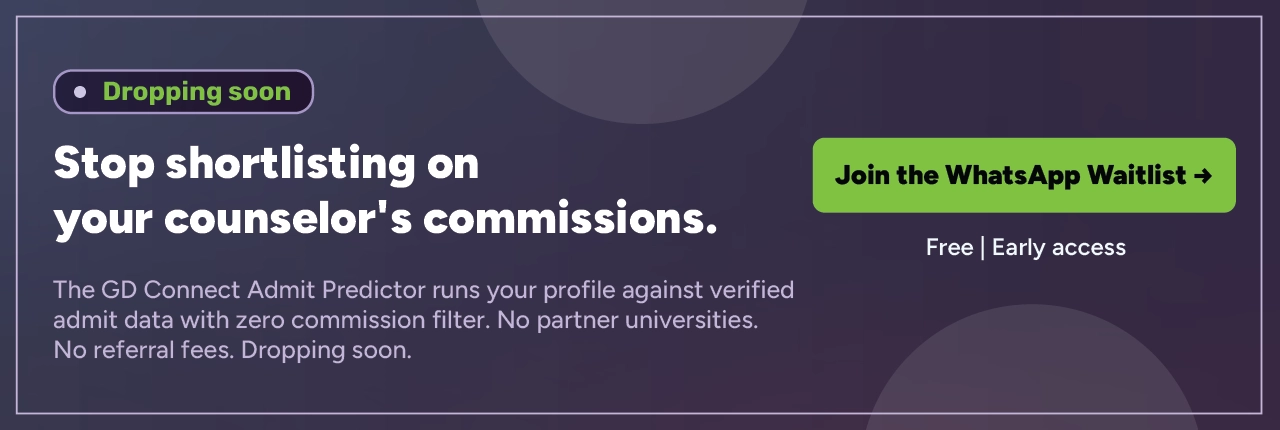
The GD Connect Admit Predictor runs your profile, GPA, GRE, background, research experience against verified admit data to show you where you actually stand across US and EU universities. It has no partner institutions. It applies no commission filter.
The output is a probability-ranked list of programs sorted by your actual admit data. It will surface universities your counselor called "too competitive." In many cases, your probability at those schools will be comparable to or higher than the schools currently on your shortlist.
This is not a guarantee of admission. What it provides is the actual data to make the shortlist decision yourself without a financial conflict sitting between you and the information.
If you have a shortlist that came from a "free" counselor, run one check before you pay any application fees: ask, explicitly, whether any universities on that list pay referral commissions to the agency. Then cross-reference your profile against programs that don't.
The cost of this check is 15 minutes. The cost of skipping it can be a full intake cycle, $7,000 in misdirected applications, or four years at a program that underdelivers on ROI.
No. Universities pay them a commission when you enroll. You don't pay, but the university does — which means their advice can be influenced by who pays them the most.
Most large public universities don't pay referral commissions to agencies. So even if your profile is competitive enough, these universities often never appear on your shortlist.
Ask your counselor directly: "Do any universities on this list have a referral agreement with your agency?" If they can't give a straight answer, verify your shortlist independently using the GD Connect Admit Predictor.
Private universities can cost ₹15–25 lakh more per year than comparable public ones. Over a two-year master's, that difference is significant — and you may also miss scholarships that agencies never mention.
Check Your Education Loan Eligibility

Ask from a community of 10K+ peers, alumni and experts
Trending Blogs

Network with a community of curious students, just like you
Join our community to make connections, find answers and future roommates..Country-Wise Loans
Best Lenders for Education Loan

ICICI Bank

Axis Bank

Union Bank

Prodigy

Auxilo

Credila

IDFC

InCred

MPower

Avanse

SBI

BOB

Poonawalla
Saraswat