



.webp)
















Help our experts understand you better by filling our 2-Minute Form, to find the right education loan
Get instant loan offer suitable to your profile !

On this Page:
Explore non STEM courses in the USA for Indian students. Understand costs, OPT rules, salary expectations, job prospects, and financial planning insights.

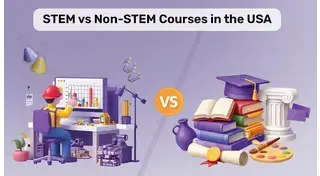
Over the years, the American higher education spotlight has been focused mainly on STEM programs. At present, however, non-stem courses in the USA are perceived with a certain sense of uncertainty, particularly among Indian students. To a large extent, this scrutiny has been due to the visa anxiety, especially with regard to less time on the OPT than on STEM pathways. Combine that with the increasing price of education, unstable employment opportunities, and viral social media stories that increase worst-case scenarios, and it is understandable why people feel hesitant.
Yet, beneath the noise lies a more nuanced reality. Non-STEM programs maintain a solid academic rigour, international experiences and professional paths, as long as students make effective and strategic decisions in line with long-term objectives instead of following fads.

Non-STEM programs are the subjects not focused on science, technology, engineering, and mathematics. These generally include classic business degrees (no analytics-focused majors), finance, management, marketing, public policy, international relations, arts, media studies, literature, psychology, and other humanities majors. These programs strive more on strategy, communication, leadership, policy, and creative thinking as opposed to technical or coding-based skills.
On the surface, there is no significant difference in the cost of studying in the U.S. with STEM or non-STEM programs. The actual difference comes after graduation, where the period of the post-study working rights has a direct impact on the financial recovery and the break-even of the investment as a whole.
| Factor | STEM Programs | Non-STEM Programs |
|---|---|---|
|
Average Tuition |
$30,000 to $60,000 USD per year |
$25,000 to $50,000 USD per year |
|
Program Duration |
1–2 years |
1–2 years |
|
OPT Duration |
Up to 3 years (with STEM extension) |
Typically 1 year |
|
ROI Pressure |
Moderate (longer work window) |
Higher (shorter time to recover investment) |
|
Financial Risk |
Spread over longer employment window |
Compressed recovery timeline |
Non-STEM degrees are only eligible for 12 months of OPT upon graduation, compared to the 24 months of OPT available to STEM-designated programs. There is no additional 24-month STEM extension, which significantly changes the job search timeline and long-term work strategy.
This implies that students have to find relevant employment within a short time. It is not only about the pressure to find a job, but also to find it as soon as possible and in a position that matches their degree. Because of the employer-dependent characteristic of OPT, students have to ensure that they retain a valid employment status to stay within the visa regulations. Legal stay can be impacted by any extended unemployment.
This gives urgency to Indian students who finance their studies by taking loans. This is where strategic selection of internships, networking in the internship period, and targeting employers who are friendly to the OPT program is critical.

The job market for graduates of non-STEM courses in the USA is opportunity-driven but highly selective. In many professions, such as management, media, public policy, and traditional business employment, employers consider practical exposure to be more important than theoretical credentials. Contrary to technical jobs where skill tests might be dominant in the hiring process, non-technical areas heavily emphasise internships, communication skills, understanding of the industry and cultural fit in U.S workplaces.
This makes early career positioning crucial. Recruiters place more importance on U.S.-based internships, part-time jobs, becoming leaders on campus, and experience in networking. For international students, especially those on a limited OPT window, gaining local exposure during the course is not just advantageous; it directly improves employability. Obtaining the degree is never sufficient; market alignment needs to start in the first semester.
Non-technical median starting salary is roughly $48,000 to $70,000 annually, based on industry, location and position. Marketing, communications, public policy, and management can be at the lower or mid end of this scale, and in finance and some business professions may have higher values. In comparison, many STEM graduates enter roles with median salaries exceeding $95,000–$105,000 annually, creating a noticeable initial pay gap.
However, salary variance within business and humanities careers is wide, and growth often depends on networking, performance, and industry mobility rather than technical specialisation in non-STEM courses in the USA.
Those students who have good internship history, prior domain experience and are career-oriented stay competitive. Applicants with niche programs that match industry demand, such as supply chain management, specialised finance policies or policy analytics, have a higher likelihood of success. Placement outcomes are further enhanced by universities that have good corporate alliances and dynamic career service offices. Whether in preparation, relevancy or positioning, success is based on the foundation of preparation, relevancy and positioning rather than a degree label.
Geography tends to be more important than brand value when it comes to career outcomes. Rankings have an impact, but with regard to businesses, media, public policy, and management, proximity to industry hubs is an essential determinant of employability. Students who take non-STEM courses in the USA are better off being in a better city with a high corporate base, internship programs, and networking opportunities, rather than enrolling in a more prestigious university or college when there is little job market.
New York, Boston, Chicago and California are more exposed in the areas of finance, consulting, communications and public affairs. The physical proximity to employers enhances access to internships, engagement with alumni, and the factor of interviews, which are important in determining employment outcomes of the study.
Excessive borrowing constitutes a lot of financial strain, particularly where the earning horizon after the studies is narrow. Increased loan values imply an increase in EMIs, restrictions in repayment schedules, and a lack of flexibility in changing jobs. Even a few weeks of unemployment can bring a strain without proper planning for the costs. The realistic repayment capacity that students are expected to compute is one that is based on low estimates of their salaries and not on the best-case scenario.
Long-term burden can be lowered by comparing lenders, being aware of the terms of moratorium, and structuring loans intelligently. Many students also seek expert guidance from education financing specialists from GyanDhan to evaluate loan options and repayment strategies before making a final decision.

Not all programs carry the same level of risk. Degrees which combine practical exposure and industry access are more likely to provide better employment stability.

Heavy reliance on big education loans, students with no prior work experience, and uncertain of their career choices should not rush to commit to non-STEM courses in the USA. A limited post-study work window combined with high financial liability can create significant pressure if job placement is delayed.
Applicants who have not had internships, exposure to the industry or a clear career pathway can find it difficult in competitive recruitment markets. If the decision is driven only by the idea of “going to the U.S.” rather than a structured professional plan, the risk increases substantially. Clarity, preparedness, and financial realism are essential before proceeding.
The conversation around non-STEM courses in the USA often exaggerates the risk. As a matter of fact, the difficulty is not often the degree, but the imbalance between ambition and preparation. Students choose programs that are not evaluated based on location, industry access, financial exposure, or career direction, which leads to increased uncertainty.
A carefully formulated decision made based on market awareness and disciplined loan policy will go a long way in mitigating that risk. A non-STEM degree taken with internships, networking and a defined career purpose can provide reliable results. The deciding factor is not the stream, but the strength of alignment between education, employability, and long-term goals.
A non-STEM degree is one that concentrates on management, communication, policy, creative industries or social sciences as opposed to technical or engineering-related subjects. These programs are not usually covered by a 24-month STEM OPT extension, but are subject to 12 months of regular OPT.
Besides engineering and technology, MIT has non-STEM programs in management, economics, business, political science and humanities via various schools and departments.
STEM courses focus on technical, scientific, and quantitative skills and often qualify for a longer OPT extension. The courses that are not STEM are usually focused on management, communication, policy, or creative studies and tend to receive 12 months of OPT.
It depends on the program. Traditional MBA programs are non-STEM. However, some universities offer STEM-designated MBA tracks, usually with analytics, data, or quantitative concentrations.
Recruitment is based on the job market and not the degree name. Degrees in computer science, engineering, data analytics, and some types of business specialisation (such as supply chain or finance) are in high demand now. What counts more than the title is the experience through internship and skills.
Check Your Education Loan Eligibility

Ask from a community of 10K+ peers, alumni and experts
Be the first to discuss this article
Ask a question or share your experience with students on GD Connect.
Add Your ResponseTrending Blogs
Similar Blogs

Network with a community of curious students, just like you
Join our community to make connections, find answers and future roommates..Country-Wise Loans
Best Lenders for Education Loan

ICICI Bank

Axis Bank

Union Bank

Prodigy

Auxilo

Credila

IDFC

InCred

MPower

Avanse

SBI

BOB

Poonawalla
Saraswat