



.webp)












Help our experts understand you better by filling our 2-Minute Form, to find the right education loan
Get instant loan offer suitable to your profile !

On this Page:
Explore community colleges in the USA for international students. Learn about the 2+2 transfer pathway, costs, GPA requirements, visa rules, and ROI benefits before choosing your college.

Studying in the U.S. has always been aspirational, but in 2026, practicality is shaping decisions more than prestige. As tuitionfees are rising and college loans are becoming a matter of close budgeting, parents are seeking less risky, less expensive points of entry. That’s where community colleges in the USA are stepping in. They are inexpensive, adaptable, and offer a viable start without compromising future goals.
For international students, especially, this pathway reduces financial pressure while keeping transfer opportunities open. What was once seen as a backup option is now becoming a strategic first move toward quality American education.

A community college pathway follows a simple 2+2 model. Students first complete a two-year associate degree. Then they move to a four-year university and complete the last two years of their bachelor's degree. This structure allows students to build academic credits gradually, adjust to the U.S. education system, and move toward a full degree in a planned, step-by-step manner.
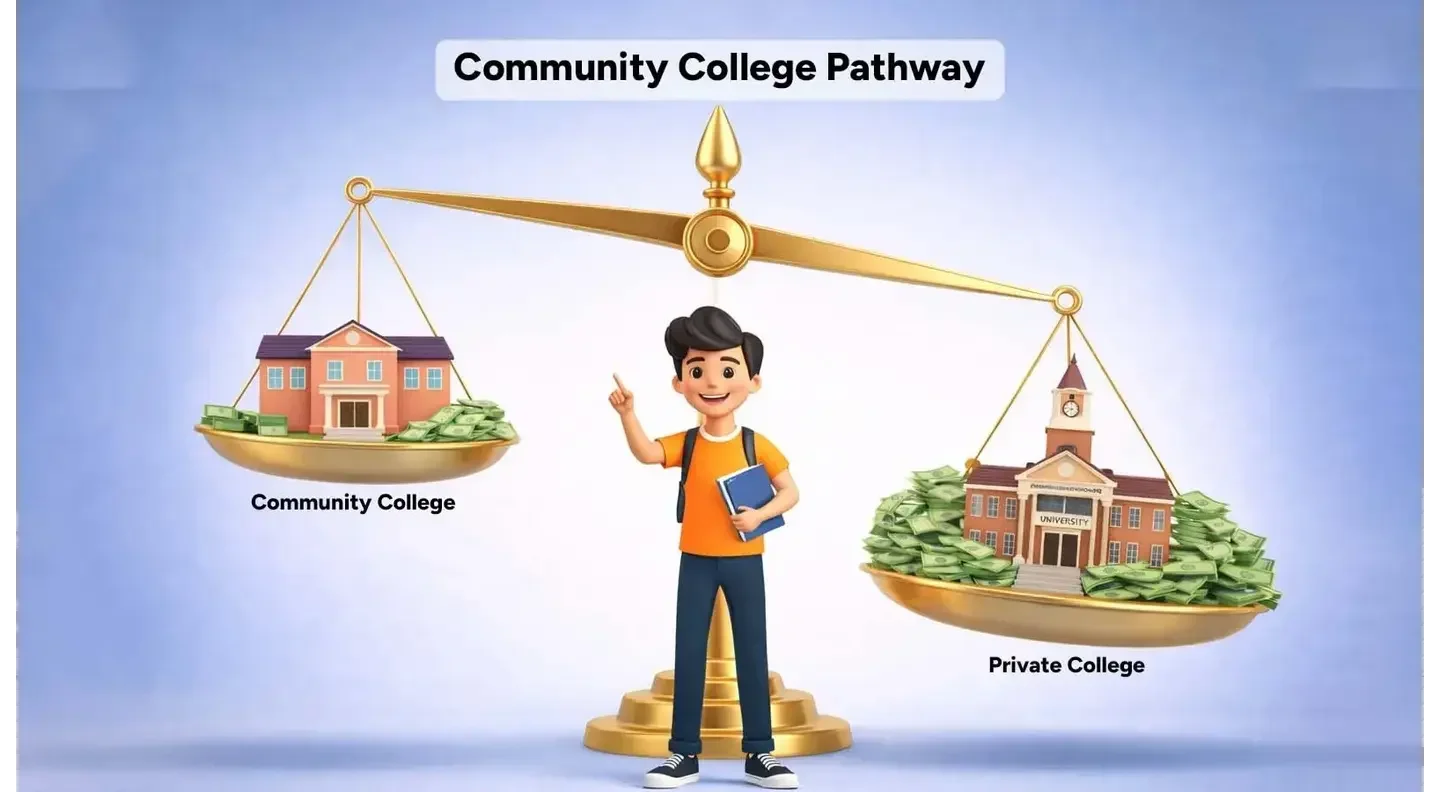
The biggest appeal of community colleges in the USA is cost. The tuition is generally 40-60% cheaper than at most four-year universities. This will help a great deal in alleviating the financial strain in the initial two years of study. The students incur fewer fees on tuition while getting transferable credits. Consequently, families reduce exposure to education loans at an earlier stage and deal with the general cost of degrees in a more rational manner without lagging in studies.

Many students hesitate because the transfer process sounds complicated. In reality, it is structured and policy-driven. Getting a clear picture of the functioning of agreements eliminates confusion and allows you to organize your academic path as clearly as possible.

Upon completion of the two-year term and transfer, students are awarded their final bachelor's degree by the four-year university. The diploma carries only the university’s name, with no mention of the transfer path or the community college where the journey began. For those considering colleges in the USA, this ensures the same academic recognition, credibility, and career value as students who started directly at the university level.
Community colleges in the USA for international students are authorised to issue the I-20 form, making students eligible for the F-1 visa, just like universities. They must maintain SEVIS compliance, full-time enrollment, and academic progress. Once students transfer and receive a four-year bachelor's degree, they are eligible to receive the same benefits of OPT as any other graduate, and their transfer to a two-year institution does not affect the benefits they receive.
Starting at a community college comes with practical advantages, but there are trade-offs. Campus life is usually smaller in scale, with fewer residential experiences and extracurricular options compared to large universities. During the first two years, on-campus recruitment opportunities may also be limited.
The four-year institutions tend to have more major career fairs and employer networks. Nevertheless, after transfer, students benefit by having access to a wider range of academic facilities, exposure to research, internships, and sources of recruitment that facilitate long-term career development.
The pathway is appropriate for students who prefer to have a structured access to higher education in the USA without high initial expenses. Budget-conscious families gain financial flexibility in the first two years. Students with average academic profiles also benefit, as admission standards are often more accessible. It is equally helpful for those who need time to adjust academically, strengthen fundamentals, or adapt to a new education system before transferring to a university.

This route may not suit students aiming directly for top-tier universities with highly competitive freshman intake. Those seeking immediate access to intensive research labs, large-scale campus networks, or brand-driven exposure from day one may find traditional four-year colleges in the USA more aligned with their goals. Similarly, students who are academically strong and financially prepared for direct university entry may not need the staged approach that community college programs typically offer.
From a financial standpoint, community colleges in the USA improve return on investment by lowering upfront tuition costs. Students spend significantly less in the first two years, which reduces overall borrowing and EMI pressure after graduation. Instead of committing to four years of high fees immediately, families distribute expenses strategically. When students later earn a bachelor’s degree from a four-year university, the long-term earning potential remains comparable, but the total education cost is often substantially lower.
Many setbacks happen due to poor planning rather than the pathway itself. Clarity at the start prevents academic and transfer issues later.
Community colleges are not shortcuts; they are structured entry points into the higher education system in the USA. They enable the students to start strategically, control expenses, and develop academic momentum until they move to a four-year university. The pathway safeguards finances and long-term plans when properly planned.
It demands discipline, GPA consistency, and informed decision-making. For international students who value flexibility and calculated risk, this model offers a practical, credible, and outcome-focused route to earning a respected U.S. bachelor’s degree.
Most community colleges require completion of high school or an equivalent qualification. English proficiency proof may be needed for international applicants. Some programs may have placement tests in math or English. Examinations such as the SAT are not mandatory.
Many community colleges have open admission policies and may accept GPAs around 2.0 or equivalent. But some specific courses, like nursing or engineering courses, might have higher GPA requirements to join or transfer admission.
Liberal arts, general studies, or business administration programs are usually deemed manageable because they offer flexible coursework. Difficulty depends more on individual strengths and academic commitment than on the program label.
Community colleges admit international students and are authorized to issue the I-20 for F-1 visas. Students must enroll full-time, maintain visa compliance, and show proof of financial support for tuition and living expenses.
Check Your Education Loan Eligibility

Ask from a community of 10K+ peers, alumni and experts
Be the first to discuss this article
Ask a question or share your experience with students on GD Connect.
Add Your ResponseTrending Blogs
Similar Blogs

Network with a community of curious students, just like you
Join our community to make connections, find answers and future roommates..Country-Wise Loans
Best Lenders for Education Loan

ICICI Bank

Axis Bank

Union Bank

Prodigy

Auxilo

Credila

IDFC

InCred

MPower

Avanse

SBI

BOB

Poonawalla
Saraswat