



.webp)













Help our experts understand you better by filling our 2-Minute Form, to find the right education loan
Get instant loan offer suitable to your profile !

On this Page:
Discover how Jansamarth Portal simplifies loan subsidies in India. Get detailed insights on eligibility, application process, and benefits for students.

Key Takeaways

Most students searching for "jan samarth education loan" or "jan samarth portal sbi" assume both government portals work the same way. They don't. The difference isn't just technical, it's strategic, and it directly affects how fast your loan gets approved and how much control you have over lender selection.
In March 2026, the JanSamarth portal reported processing over 41.14 lakh applications with sanctions exceeding ₹84,365 crore. Meanwhile, PM Vidya Lakshmi sanctioned 3.31 lakh education loans in its first year under the upgraded scheme, with a 50.8% approval rate. Both numbers sound impressive. But students who applied to both portals in 2025-2026 noticed something the marketing material doesn't mention: the JanSamarth loan approval timeline can stretch 3-4 weeks even when the portal promises "59-minute approval," while Vidya Lakshmi consistently delivers in-principle responses within 15-30 days depending on lender workload.
The question isn't which portal is better, it's which one matches your financing strategy. If you're chasing interest subsidy benefits under CSIS or minority schemes, JanSamarth portal registration makes sense. If you want to compare 45+ banks, apply to three simultaneously, and move faster through lender verification, PM Vidya Lakshmi wins. And if you're a student at an IIT, NIT, IIM, or any NIRF-ranked institution in the top 200, the PM Vidyalaxmi Scheme offers collateral-free financing that neither JanSamarth nor traditional bank routes match.
Here's what most guides miss: both portals are routers, not lenders. The actual approval doesn't come from the portal, it comes from the bank on the other end. That means your document quality, co-applicant income consistency, and chosen institution's lender approval history matter more than which digital form you filled out first.


Most students assume both portals work the same way. They don't. One routes you through subsidy schemes, the other lets you compare lenders directly.
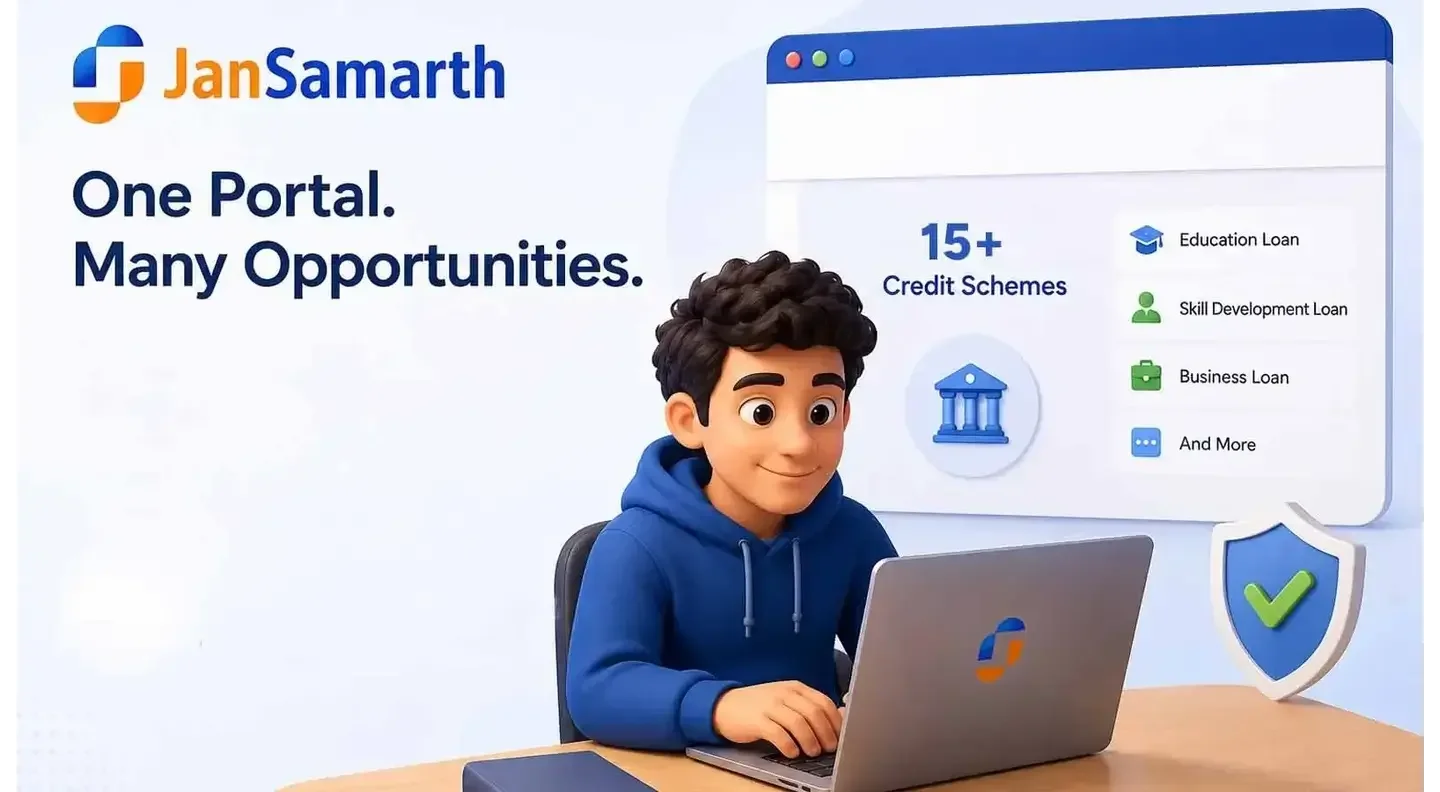
Launched in June 2022 under the Atmanirbhar Bharat Abhiyan, the JanSamarth portal was designed to centralize access to 15 credit-linked government schemes across education, agriculture, business activity, livelihood, renewable energy, and housing. For students specifically, the portal connects borrowers to subsidy programs like the Central Sector Interest Subsidy Scheme (CSIS), Padho Pardesh, and Dr. Ambedkar Scheme—programs where the government pays the interest during your moratorium period if you meet income eligibility criteria.
The platform currently works with 254+ lenders including 12 public sector banks, 20 private banks, 28 regional rural banks, 6 small finance banks, NBFCs, and cooperative banks. When you search "jansamarth portal sbi," you're looking at SBI as one of many participating lenders under schemes like CSIS, PMMY (MUDRA), PMEGP, and PM SVANidhi.
But here's what students often misunderstand: JanSamarth doesn't function as a neutral loan marketplace. It's a scheme-first platform. You don't browse lenders freely as you apply under a specific government scheme, the portal checks your eligibility against that scheme's criteria, then routes your application to participating lenders who handle that program. If your family income exceeds ₹4.5 lakh annually, you won't qualify for CSIS subsidy through JanSamarth, even if you're applying for the exact same education loan that SBI would approve through direct application or Vidya Lakshmi.
PM Vidya Lakshmi launched in 2015 as a student-first comparison platform, and it got a major upgrade in November 2024 when the Union Cabinet approved the PM Vidyalaxmi Scheme. Unlike JanSamarth, this portal doesn't route you through government schemes, it presents you with loan options from 45+ banks and lets you compare interest rates, collateral requirements, and repayment terms before applying to up to three lenders simultaneously using a single Common Education Loan Application Form (CELAF).
The platform currently hosts 86-139 education loan schemes (sources vary based on reporting period) from public and private sector banks. When you complete the CELAF form, your application reaches all three chosen banks at once. Each bank runs its own verification, and you can track all three applications from one dashboard. If Bank A takes too long or rejects, you've already got Bank B and Bank C reviewing your file—you haven't wasted weeks waiting for sequential responses.
The PM Vidyalaxmi Scheme added several features that make Vidya Lakshmi more attractive in 2026:
The Vidya Lakshmi approach is fundamentally different: it's lender-agnostic. You're shopping for the best loan terms, not applying under a government scheme with pre-set subsidy rules.
Here's where the timeline actually breaks.
The JanSamarth portal marketing states that eligible borrowers can receive in-principle approval in as little as 59 minutes for selected schemes. This claim isn't technically false, it's just incomplete.
What actually happens:
The "59-minute approval" refers to the portal's automated eligibility check, not the lender's sanction. Most JanSamarth education loan delays happen between steps 3 and 4, during lender-side verification. According to borrower reports from 2025-2026, the full journey from application to disbursal through JanSamarth typically takes 20-45 days, with subsidy-linked loans sometimes stretching to 60+ days when government departments need to verify income certificates or caste/category documents.
One 2025 case from Noida involved a student who applied through JanSamarth SBI education loan for a ₹28 lakh overseas education loan. The portal gave in-principle approval on Day 1, but SBI's RACPC branch handling education loans flagged the co-applicant's freelance income documents because they didn't match the latest ITR filings. After updated income proofs and bank statements were submitted, the application moved forward but final sanction took 16 days from initial submission, not 59 minutes.
PM Vidya Lakshmi doesn't promise 59-minute approvals because it doesn't need to. The platform positions itself differently: apply once, reach three banks, track everything transparently, and wait for actual lender responses rather than automated eligibility checks.
Vidya Lakshmi timeline:
The difference is transparency. When you log into your Vidya Lakshmi dashboard, you see exactly where each of your three applications stands: "Under Review," "Documents Pending," "Approved," or "Rejected." If Bank A drags its feet, you already have Bank B and Bank C working in parallel. This multi-lender approach is why Vidya Lakshmi applicants report faster effective approval even though the per-bank timeline isn't necessarily shorter than JanSamarth.
The July 2025 directive from the Finance Minister asking public sector banks to clear education loan files within 15 working days was aimed at reducing portal backlogs but it applies equally to both JanSamarth and Vidya Lakshmi applications. The real bottleneck isn't the portal, its lender workload and document verification quality.
After analyzing borrower experiences from 2025-2026, the common delay points are identical regardless of portal:
The question isn't which portal is better but it's which one matches your loan profile.
Portal features get attention. Bank behavior doesn't. Here's what matters more than which website you clicked.
This is the most common misconception. The portal is a connection tool as it digitizes the application process and routes your documents to lenders. The actual sanction decision comes from the bank, not the platform. That means your approval chances depend on:
Submitting through JanSamarth doesn't guarantee subsidy approval, and submitting through Vidya Lakshmi doesn't guarantee collateral-free financing unless you meet the specific scheme criteria.
Nothing stops you from applying through JanSamarth for subsidy-linked loans and simultaneously using Vidya Lakshmi for broader lender comparison. If you qualify for CSIS (income under ₹4.5 lakh), apply through jansamarth csis to lock in that benefit. Then use Vidya Lakshmi to apply to three additional banks offering competitive rates without subsidy dependency. Some students did exactly this in 2025-2026 and ended up with 4-5 parallel applications running across both portals.
The risk: managing multiple lender interactions simultaneously requires discipline. You'll need to track document requests, respond to verification calls, and coordinate disbursals carefully. But if speed matters and you want maximum lender exposure, dual-portal application isn't against any rules.
SBI processes jan samarth portal sbi applications through its Regional Accounts and Credit Processing Cells (RACPCs) for education loans. The same RACPC handles Vidya Lakshmi applications from SBI. Canara Bank's Bengaluru processing center reviews both JanSamarth and Vidya Lakshmi applications using identical credit policies. Union Bank's education loan vertical doesn't differentiate based on portal source as they verify co-applicant income, admission validity, and collateral in exactly the same way.
What changes is the scheme context. A JanSamarth application under CSIS arrives at the bank with subsidy eligibility already flagged, so the lender knows they'll need to verify government income certificates and submit claims to the Department of Higher Education after disbursal. A Vidya Lakshmi application without subsidy linkage skips that step, potentially saving 5-7 days in verification.
If your loan amount is under ₹7.5 lakh and you're at an NIRF-ranked institution: Vidya Lakshmi + PM Vidyalaxmi Scheme is unbeatable. Collateral-free, guarantor-free (in many cases), 75% government credit guarantee, and 3% interest subvention if income under ₹8 lakh.
If your loan amount is ₹20-50 lakh and you need collateral-based financing: Both portals connect you to the same lenders (SBI, Canara, Bank of Baroda, HDFC, Axis). Vidya Lakshmi's comparison feature and parallel application capability give you better visibility.
If subsidy eligibility is your top priority: JanSamarth is designed for this. The platform automatically routes you to subsidy-compatible lenders and ensures your application gets flagged correctly for interest benefit claims.
If you're a borderline case (income ₹5-8 lakh, non-QHEI institution): Neither portal gives you overwhelming advantage. Apply through both, compare responses, and choose whichever lender offers the best terms after verification.
Document quality, not portal choice, causes most delays. Here are the mistakes that slow down both platforms equally.
Both JanSamarth and Vidya Lakshmi require scanned copies of Aadhaar, PAN, admission letters, income proof, bank statements, and academic records. Blurry scans, cropped PDFs, or documents with mismatched names cause banks to send clarification requests, adding 3-7 days to processing. Before uploading, check:
Some students complete jansamarth portal registration or Vidya Lakshmi CELAF submission before receiving their final admission offer, hoping to speed up the loan once admission arrives. This backfires. Banks put your file on hold or reject it outright if you don't have a valid admission letter at submission. The restart cost, reapplying, re-uploading, getting back in the lender queue wastes more time than if you'd waited for admission first.
The platform lets you apply to three banks simultaneously. Many students pick just one (usually SBI or Canara Bank) and wait. If that bank delays or rejects, they've wasted 15-30 days. Apply to all three slots preferably a mix of public sector banks (lower rates, slower processing) and private banks or NBFCs (higher rates, faster processing). This hedges your timeline risk.
Both portals check co-applicant creditworthiness. A CIBIL score below 650 raises red flags even if income documents look strong. If your parent's credit history includes late payments, defaults, or high credit utilization, address this before applying. Even a 3-month track record of timely EMI payments can improve approval odds.
Both JanSamarth and Vidya Lakshmi offer status tracking dashboards. Students who log in weekly and respond immediately to bank queries (document re-uploads, clarification calls, collateral schedules) move through verification 5-10 days faster than those who ignore their portal accounts. Set a calendar reminder to check status every Monday.
Priya, a student from Jaipur, secured admission to the MSc in Data Science program at Imperial College London for September 2025 intake. Estimated cost: ₹45 lakh for tuition + living expenses over 1 year. Family income: ₹6.8 lakh annually (above CSIS ceiling, below PM Vidyalaxmi subvention ceiling).
Strategy:
Timeline:
Result: Priya chose SBI's offer because the 9.85% rate and full ₹45 lakh coverage matched her requirement, even though it needed collateral. Canara Bank's slightly lower rate wasn't worth the reduced loan amount. Axis Bank served as her backup approval.
The lesson: Using both portals gave her 5 simultaneous applications (2 via JanSamarth, 3 via Vidya Lakshmi). Even though not all banks approved, having options meant she could negotiate timelines and compare terms after sanction rather than accepting the first offer out of desperation.
Everything that differentiates the two platforms, features, timelines, lender pools, subsidy integration in one table.
|
Primary Focus |
Subsidy-linked government schemes |
Lender comparison marketplace |
|
Number of Lenders |
254+ (PSBs, private banks, RRBs, SFBs, NBFCs) |
45+ banks |
|
Loan Schemes Available |
15 schemes across 6 categories (Education, Agri, Business, Livelihood, Renewable Energy, Housing) |
86-139 education loan schemes |
|
Application Approach |
Scheme-first routing based on eligibility |
Lender comparison, apply to 3 banks simultaneously |
|
Processing Speed (Portal) |
"59-minute approval" (automated eligibility check only) |
15-30 days (actual lender response time) |
|
Full Approval Timeline |
20-60+ days including lender verification and subsidy checks |
15-40 days depending on lender and loan complexity |
|
Subsidy Integration |
Strong—CSIS, Padho Pardesh, Dr. Ambedkar Scheme directly accessible |
PM Vidyalaxmi Scheme subsidy (3% interest subvention) integrated; CSIS linkage indirect |
|
Collateral-Free Options |
Limited; depends on scheme and lender |
Up to ₹7.5 lakh collateral-free under PM Vidyalaxmi Scheme for QHEI students |
|
Income Ceilings for Benefits |
₹4.5 lakh (CSIS) |
₹8 lakh (PM Vidyalaxmi 3% subvention) |
|
Overseas Education Support |
Available but scheme-dependent |
Broad lender participation; strong overseas education focus |
|
Domestic Education Support |
Strong subsidy schemes for Indian institutions |
Comprehensive coverage across all recognized institutions |
|
Application Form |
Scheme-specific forms |
Single CELAF (Common Education Loan Application Form) |
|
Simultaneous Applications |
Single lender per application; multiple schemes possible |
Up to 3 banks per CELAF submission |
|
Status Tracking |
Portal dashboard with lender updates |
Detailed dashboard showing all 3 applications with bank-specific remarks |
|
Grievance Support |
Portal-level grievance system |
Portal-level grievance + direct bank nodal officer escalation |
|
Best For |
Subsidy-seeking borrowers, income under ₹4.5 lakh, scheme-eligible categories |
Lender comparison, faster processing, QHEI students, overseas education |
The honest answer: neither portal directly speeds up your approval, the lender does. But if forced to choose based on structure and borrower experience:
PM Vidya Lakshmi delivers faster effective results for most students because:
JanSamarth serves a different purpose, subsidy optimization, not speed optimization. If you qualify for CSIS (income under ₹4.5 lakh) or other targeted schemes, the 5-10 extra days spent on subsidy verification save you ₹2-6 lakh in interest costs. That's a trade worth making.
The students who move fastest in 2026 do this:
The portal doesn't approve your loan. The bank does. But the portal you choose determines how many banks see your application, how quickly they respond, and what terms you're eligible for. Choose strategically.
The question "JanSamarth vs PM Vidya Lakshmi—which portal speeds up education loan approval?" assumes both platforms compete on the same axis. They don't. JanSamarth optimizes for subsidy access and government scheme routing. PM Vidya Lakshmi optimizes for lender comparison and parallel processing. Your approval speed depends less on which digital form you filled out and more on whether your documents are consistent, your co-applicant's income is stable, your institution is lender-approved, and your chosen bank has processing bandwidth when your file arrives.
Most students waste time researching portals when they should be fixing their co-applicant's CIBIL score, reconciling income proof inconsistencies, or confirming their university appears on their target lender's approved list. The portal is just a router. The approval decision happens at the bank and that's where preparation matters.
That said, if you're a student at an IIT, NIT, IIM, or any NIRF top-200 institution, PM Vidya Lakshmi offers structural advantages in 2026 through the PM Vidyalaxmi Scheme that JanSamarth can't match: collateral-free financing, government credit guarantee, and faster lender confidence because risk is partially transferred. For subsidy-eligible students (income under ₹4.5 lakh), JanSamarth's CSIS routing remains the better financial choice even if it takes 5-10 days longer.
The real move: apply through both portals if you're borderline. Cover your bases. Get 5 lenders reviewing your file instead of 1-2. Track both dashboards. Respond to whichever lender moves fastest. Because in the end, the approval you get by your visa interview date matters more than which government website deserved the credit.
Need help navigating the abroad education loan process beyond government portals? Platforms like GyanDhan specialize in matching students with the right lenders based on university, course, profile, and co-applicant strength, often achieving sanction timelines that beat both jan samarth portal and Vidya Lakshmi through direct lender relationships and application support. Explore your options, compare all routes, and choose the path that gets you to your dream university on time.

The JanSamarth portal is a government-backed digital platform launched in June 2022 that connects Indian citizens to 15 credit-linked schemes across education, agriculture, business activity, livelihood, renewable energy, and housing. For students, it provides access to education loan schemes with government interest subsidies like CSIS (Central Sector Interest Subsidy Scheme). The portal works with 254+ lenders including public sector banks, private banks, RRBs, SFBs, and NBFCs. After jansamarth portal registration, students select a scheme, check eligibility, upload documents, and the portal routes applications to participating lenders for verification and approval.
PM Vidya Lakshmi operates as a lender comparison marketplace where students fill one Common Education Loan Application Form (CELAF) and apply to up to three banks simultaneously from 45+ participating lenders. JanSamarth routes applications through specific government schemes first, then connects students to scheme-approved lenders. Vidya Lakshmi focuses on broader lender comparison and parallel processing, while JanSamarth emphasizes subsidy-linked financing for eligible income categories and schemes.
Neither portal approves loans but banks do. However, PM Vidya Lakshmi typically delivers faster effective results (15-30 days average) because students can apply to three banks at once, increasing the chance of at least one quick response. JanSamarth processing can take 20-60+ days depending on scheme verification requirements, especially for subsidy-linked applications that need government income certificate validation. The actual speed depends more on document quality and lender workload than portal choice.
Yes. Many students apply through JanSamarth for subsidy-eligible schemes (like CSIS if family income is under ₹4.5 lakh) and simultaneously use Vidya Lakshmi to apply to three additional banks for broader lender coverage. This gives you 4-5 parallel applications running at once, increasing approval chances and reducing dependency on any single lender's timeline. Just ensure you can manage multiple lender interactions and document requests simultaneously.
The PM Vidyalaxmi Scheme was launched in November 2024 as an upgrade to the PM Vidya Lakshmi portal. It offers collateral-free and guarantor-free education loans for students admitted to Quality Higher Education Institutions (QHEIs) 860+ institutions including IITs, NITs, IIMs, and state government colleges ranked 101-200 in NIRF. Benefits include 75% government credit guarantee for loans up to ₹7.5 lakh and 3% interest subsidy for students from families with annual income up to ₹8 lakh. The scheme aims to support 22 lakh students annually.
The Central Sector Interest Subsidy Scheme (CSIS) provides full interest subsidy during the moratorium period (course duration + 1 year) for economically weaker students pursuing higher education in India. Eligibility: family income up to ₹4.5 lakh annually. To apply, complete jansamarth portal registration, select CSIS under the Education category, provide income proof and admission documents, and submit. The portal routes your application to participating lenders who verify subsidy eligibility before sanctioning.
Not necessarily. SBI processes jan samarth portal sbi applications through the same Regional Accounts and Credit Processing Cells (RACPCs) that handle direct applications and Vidya Lakshmi submissions. The difference is context: if you apply through JanSamarth under a scheme like CSIS, your application arrives with subsidy eligibility flagged, which can improve terms if you qualify. But if your income exceeds scheme ceilings, direct application or Vidya Lakshmi may offer more flexibility and faster processing.
The "59-minute approval" refers to the portal's automated eligibility check, not the lender's final sanction. After you submit through JanSamarth, the portal verifies your basic details against scheme criteria and routes your application to participating banks, this initial step can happen within an hour. But lenders then conduct their own verification (income proof, co-applicant credit, admission validity, collateral if needed, subsidy confirmation), which takes 5-25 additional days. The full timeline from submission to disbursal typically ranges from 20-60+ days.
Yes, but eligibility varies. Under the PM Vidyalaxmi Scheme on Vidya Lakshmi, students admitted to QHEIs can access collateral-free loans up to ₹7.5 lakh with 75% government credit guarantee. JanSamarth offers some collateral-free options under schemes like MUDRA (for business loans) but education loan collateral requirements depend on the specific lender and loan amount. Loans below ₹7.5 lakh from many banks are collateral-free regardless of portal, while loans above ₹7.5 lakh typically require security.
Both portals require similar documents: Aadhaar card, PAN card, admission letter from recognized institution, academic marksheets, fee structure, co-applicant income proof (salary slips/ITR/Form 16 for salaried; ITR/bank statements/GST returns for self-employed), co-applicant bank statements (6 months), passport-size photographs, and address proof. For jansamarth csis applications, you also need a valid income certificate from competent authority. For Vidya Lakshmi PM Vidyalaxmi Scheme benefits, QHEI admission confirmation is required.
PM Vidya Lakshmi doesn't approve loans—the banks you apply to do. Typical timeline: 2-7 days for banks to receive and review CELAF applications, 10-21 days for document verification and credit assessment, and 15-30 days for final sanction depending on loan complexity and lender workload. Students who apply to three banks simultaneously often receive at least one approval within 15-25 days. Factors affecting speed include document completeness, co-applicant credit score, institution approval status, and whether collateral valuation is needed.
PM Vidya Lakshmi generally offers broader lender participation for overseas education financing because it connects students to banks like SBI Global Ed-Vantage, HDFC Credila, Axis Bank, and ICICI Bank that specialize in abroad education loans. JanSamarth supports overseas education through schemes like Padho Pardesh (for minority community students) and Dr. Ambedkar Scheme (for OBC/EBC students), but scheme eligibility filters may limit options. For non-subsidy-dependent abroad loans, Vidya Lakshmi's comparison approach and simultaneous application to three banks offers more flexibility.
Yes. After jansamarth portal registration and application submission, log in to the portal and navigate to the "My Applications" section. The dashboard shows your application status (submitted, under review, sanctioned, or rejected) and displays any lender remarks or document requests. If a lender doesn't respond within expected timelines, you can raise a grievance through the portal's grievance system or contact the bank's education loan nodal officer directly.
CELAF stands for Common Education Loan Application Form. It's a standardized digital form on PM Vidya Lakshmi that students fill once and can submit to up to three banks simultaneously. The form includes personal information, academic details, course and cost information, co-applicant financial details, and document uploads. CELAF eliminates the need to fill separate application forms for each bank, streamlining the process and allowing students to compare multiple lender offers after submission.
Yes, but eligibility depends on the specific scheme and lender. Some JanSamarth education loan schemes (especially subsidy-linked programs like CSIS) have restrictions on institution type as they may prioritize government institutions, UGC-recognized universities, or institutions on approved lists. Private universities recognized by UGC and accredited bodies generally qualify, but students should verify with the selected lender before applying. Vidya Lakshmi typically has broader acceptance of private institutions across its 45+ participating banks.
The annual family income ceiling for the Central Sector Interest Subsidy Scheme (CSIS) through Jansamarth csis is ₹4.5 lakh. Students whose parental annual income exceeds this limit do not qualify for the interest subsidy benefit. Income must be verified through a certificate issued by a competent public authority (typically a Tehsildar or equivalent). The subsidy covers the entire interest accrued during the course period and moratorium (1 year after course completion) on education loans taken for professional and technical courses in India.
Rejection speed varies by bank workload, internal credit policies, and automated screening systems. Public sector banks often take longer to review applications but may offer lower interest rates, while private banks and NBFCs use digital underwriting systems that can reject (or approve) within 3-7 days if documents or co-applicant credit don't meet thresholds. Common quick rejection triggers include CIBIL score below 650, incomplete admission documents, unrecognized institution, co-applicant debt-to-income ratio above bank limits, or loan amount exceeding student's course cost by more than permitted margins.
Technically yes, but the process varies by lender. If you applied through JanSamarth and want to cancel before lender sanction, log into the portal, check if a "withdraw" or "cancel" option is available for your application status. If not, contact the lender directly and request application closure. Some lenders may mark it as "withdrawn" or "rejected" on the portal. After closure confirmation, you can reapply under a different scheme or to a different lender. Note that frequent cancellations may affect how lenders perceive your seriousness.
No. PM Vidya Lakshmi portal registration and CELAF submission are completely free. However, participating banks may charge loan processing fees (typically 0.5%-2% of loan amount), administrative fees, or documentation charges as per their individual policies. These bank-level fees are standard across all application channels (direct, Vidya Lakshmi, or JanSamarth) and are not imposed by the portal itself.
For JanSamarth: Log into the portal, check your application status for lender remarks, and contact the lender's education loan branch directly. If there is no response, raise a grievance through the portal's grievance section. For Vidya Lakshmi: Banks are expected to respond within 15-30 days per government guidelines. If a bank doesn't update status, you can escalate to the bank's nodal officer for education loans or raise a grievance through the Vidya Lakshmi portal's grievance mechanism. Both portals also allow you to reapply to new lenders if one bank is unresponsive.
Check Your Education Loan Eligibility

Ask from a community of 10K+ peers, alumni and experts
Be the first to discuss this article
Ask a question or share your experience with students on GD Connect.
Add Your ResponseTrending Blogs
Similar Blogs

Network with a community of curious students, just like you
Join our community to make connections, find answers and future roommates..Country-Wise Loans
Best Lenders for Education Loan

ICICI Bank

Axis Bank

Union Bank

Prodigy

Auxilo

Credila

IDFC

InCred

MPower

Avanse

SBI

BOB
Poonawalla
Saraswat