



.webp)




















Help our experts understand you better by filling our 2-Minute Form, to find the right education loan
Get instant loan offer suitable to your profile !


On this Page:
Most psychology PhDs in the USA are fully funded by the program, not by scholarships. See what Indian students can actually apply for, verified funding data, and the honest strategy for 2026.

Quick Summary:
| What most guides tell you | What actually happens |
|---|---|
|
Hunt for scholarships to fund your PhD. |
Roughly 80 to 90% of respected psychology PhD programs fund students directly through the admission offer, not through external scholarships. |
|
Apply for the NSF Graduate Research Fellowship. |
Indian students on an F-1 visa are not eligible. NSF restricts it to US citizens, nationals, and green-card holders. |
|
Fulbright-Nehru funds your US PhD. |
It funds 6 to 9 months of dissertation research for scholars already registered for a PhD in India, and its current cycle fields do not include psychology. |
|
A US PhD costs over USD 100,000 a year. |
A fully funded PhD often costs you close to nothing and pays a living stipend of USD 20,000 to USD 40,000 a year. |
|
Clinical and research psychology are funded the same way. |
Research subfields are the easiest to fund, clinical PhDs are funded but brutal to enter, and most PsyD programs are largely unfunded. |
|
A funded clinical PhD guarantees a US career. |
F-1 students hit licensing and internship walls that most guides never mention. |
The most expensive mistake an Indian student makes while planning a PhD in psychology in the USA is not picking the wrong university. It is spending months chasing the wrong kind of money. Most guides hand you a list of ten scholarships and tell you to apply. But at a good US psychology department, the funding does not come from a scholarship you win. It comes bundled into the admission itself, and if you do not know that, you spend your energy on the wrong battle entirely. Some of those celebrated awards are ones you cannot even legally apply for.
This matters more each year, not less. According to Ministry of Education data placed before the Rajya Sabha, the number of Indian students going abroad for higher education fell from about 9.08 lakh in 2023 to 7.7 lakh in 2024 to 6.26 lakh in 2025, based on Bureau of Immigration figures, with the USA still a leading destination. Fewer students are going, competition for funded seats is tighter, and the margin for a wasted application cycle is smaller than it has ever been.
The reality is different, and worth getting right before you spend a single application fee. What follows is how a fully funded PhD in psychology in the USA actually pays its students, what Indian students can genuinely apply for, and where financing honestly fits in, checked against primary sources including the NSF and the United States-India Educational Foundation.

At a reputable US psychology department, funding is usually part of the admission offer, not a separate scholarship you chase. When a strong program admits you, the offer letter typically bundles a full tuition waiver, an annual living stipend, and health insurance, usually guaranteed for five years. This is the part that trips up Indian applicants most: they arrive expecting to assemble funding piece by piece, the way an undergraduate stitches together scholarships, when in reality a single funded admission does the whole job at once.
The stipend is not charity. It is paid for work, through a Teaching Assistantship (helping teach undergraduate courses) or a Research Assistantship (working on your advisor's funded research). You are effectively an employee of the department while you earn your doctorate.
Psychology PhD stipends in the USA generally range from about USD 20,000 to USD 35,000 a year, rising to USD 40,000 in high-cost cities. This is why framing a doctorate as a six-figure annual expense is misleading for the funded path. Your real job is not to assemble a portfolio of scholarships. It is to get admitted into a program that funds you, because the funding follows the admission.

The table below separates the PhD psychology scholarships in the USA for Indian students you can realistically pursue from what you cannot, with the eligibility rule stated plainly.
| Funding source | Can an Indian F-1 student apply? | What it actually is |
|---|---|---|
|
University assistantships and fellowships (TA/RA) |
Yes |
The main funding engine. Comes with your admission offer at most reputable programs |
|
No |
NSF restricts it to US citizens, nationals, and permanent residents. Foreign nationals on a student visa are explicitly ineligible |
|
|
Only if you are a US immigrant or the child of immigrants |
Built for new Americans, not for fresh applicants arriving from India on a visa |
|
|
Only if you are already registered for a PhD in India |
Funds 6 to 9 months of US research, not a full US degree. Current cycle fields do not include psychology |
|
|
Yes, for women |
Supports women in full-time graduate or postdoctoral study in the US |
|
|
Yes, subject to each grant's terms |
Discipline-specific graduate research grants, typically modest top-ups |
|
|
Yes |
Indian award for higher study abroad, structured largely as a loan-scholarship |
|
|
Yes, subject to conditions |
Indian foundation supporting postgraduate study abroad |
NSF Graduate Research Fellowship tops nearly every list. But its eligibility page, updated August 2026, is explicit: applicants must be US citizens, nationals, or permanent residents, and foreign nationals on a student visa are named as ineligible. There is no exception. For an Indian student on an F-1 visa, the NSF GRFP is simply not an option.

The universities below run some of the best fully funded psychology PhD programs in the USA, guaranteeing multi-year funding to admitted students. Funding is confirmed at admission, not applied for separately afterward.
| University | Funding (all fully funded) | Notably strong in |
|---|---|---|
|
Tuition, insurance, and stipend |
Clinical, cognitive, developmental, social |
|
|
Tuition and stipend via RA/TA |
Cognitive, neuroscience, social |
|
|
Tuition, stipend, research funding |
Clinical, cognitive, developmental |
|
|
Tuition waiver, stipend, research funding |
Cognitive, clinical science, social-personality |
|
|
Tuition, insurance, and stipend |
Social, clinical, developmental, biopsychology |
|
|
Tuition, insurance, and stipend |
Cognitive, social, neuroscience |
|
|
Tuition and stipend, plus summers |
Clinical, cognitive, social, personality |
|
|
Tuition, ten-month stipend, summer funding |
Clinical, cognitive, social, behavioral neuroscience |
|
|
Fellowship: tuition, fees, stipend |
Cognition, neuroscience, social-personality |
|
|
Full funding, all admitted students |
Social, cognitive, neuroscience (no clinical track) |
Two things to remember while reading any list like this. Funding policy is set at the department level, so confirm the exact package and current subfield offerings on the department's own page before you apply. And a smaller, fully funded program is almost always a better financial outcome than a bigger-name program that admits you without funding.
Knowing which universities fund their students is only half the decision. The other half is which kind of psychology you pursue, because a fully funded PhD in psychology in the USA is not one reality. There are at least three, and the differences are large enough to reshape your finances.
| Path | Funding reality | Typical debt at graduation |
|---|---|---|
|
Research subfields (cognitive, social, developmental, experimental) |
Easiest to fund. Built around research labs, funded through RAs and TAs. Full funding is the norm at reputable departments |
USD 0 to USD 50,000, mostly from undergrad |
|
Clinical psychology PhD |
Usually funded at respected programs, but among the most competitive admissions in any field. The funding is real, the door is narrow |
USD 0 to USD 50,000 if funded |
|
PsyD (practice-focused doctorate) |
Mostly unfunded or only partially funded. Fully funded PsyD programs are rare exceptions |
USD 150,000 to USD 300,000 on unfunded private paths |
Debt figures are as reported across the field and vary by program.
A funded PhD leaves most graduates with little to no program debt. An unfunded PsyD can leave you owing more than a house. The field's own common advice is blunt: if your only offer is an unfunded program, it is often wiser to strengthen your application and reapply to a funded one than to take on that debt.
For an Indian student, the rule is simple:

Suppose you have done everything right so far: picked a funded program, targeted the clinical track, cleared its brutal admissions. There is still a trap waiting downstream that almost no funding guide discusses, and it can quietly derail a US clinical career.
To become a licensed psychologist in the US, you must complete a supervised predoctoral internship, matched through a national system run by the Association of Psychology Postdoctoral and Internship Centers (APPIC). This is a step that no psychology PhD funding in the USA can shortcut. That match is competitive for everyone. For F-1 students it is harder, for a specific reason:
The wall does not end at internship. State licensing boards typically require a large volume of supervised clinical hours, often 3,000 to 4,000 in total, split between predoctoral and postdoctoral training. The postdoctoral portion alone can add a year or more after the PhD before you can sit for licensure, and requirements vary by state.
None of this makes a clinical PhD a bad idea. It means a clinical psychology PhD scholarship in the USA that covers your funding is not automatically a funded path to US licensure and practice. If your real aim is to practice as a psychologist, factor the internship and licensing reality in at the start, not in year five. For research-oriented subfields, this trap does not apply, which is one more reason the clinical-versus-research choice matters so much.

Beyond university funding, a few India-side official channels can help. Here they are with their real scope stated honestly, since most lists overstate what they cover.
One caution on all India-side awards: they are almost always partial. They can reduce your burden meaningfully, but for a full US doctorate, the university's own funding package remains the decisive factor.
If most good psychology PhDs are funded, when does financing actually fit? In a few specific cases: an admission you value where funding does not cover living costs in an expensive city, an unfunded clinical or PsyD path you have decided is worth the cost, a master's-first bridge into a funded PhD, or backup liquidity so a delayed stipend does not derail you.
One technical point most students miss: under RBI's study-abroad loan framework, scholarships and assistantships count toward the loan margin, the portion you must fund yourself. Your funded stipend can therefore shrink how much you actually borrow. Chase full funding first. If a real gap remains, size the loan to that gap, not to the whole cost.
Since funding follows admission, your energy belongs in the application. Winning a fully funded PhD in psychology in the USA rewards things a standard checklist misses.
Apply early, track every deadline, and treat the funded offer, not merely the admission, as the goal. An unfunded admission to a prestigious name is not the win it appears to be.
The sticker figures for a US doctorate are real, but on the funded path they describe a cost someone else largely absorbs. Separate gross cost from net cost, and the picture changes completely.
| Expense category | Gross estimate per year (USD) | Approx. in INR | What a funded student pays |
|---|---|---|---|
|
Tuition |
20,000 to 45,000 |
17.6 to 39.6 lakh |
Covered by tuition waiver |
|
Living expenses |
15,000 to 25,000 |
13.2 to 22 lakh |
Offset by the stipend |
|
Health insurance |
1,500 to 3,000 |
1.3 to 2.6 lakh |
Usually covered by the funding package |
|
Research and conference costs |
3,000 to 10,000 |
2.6 to 8.8 lakh |
Often supported by the lab or department |
Conversions at approximately USD 1 = INR 88.
On the funded path, tuition is waived, insurance is covered, and a stipend of USD 20,000 to USD 40,000 (roughly INR 17.6 lakh to INR 35 lakh) is paid to you. The net position is often close to break-even, the opposite of the six-figure annual burden this topic is usually framed around. The heavy cost shows up only on unfunded paths.
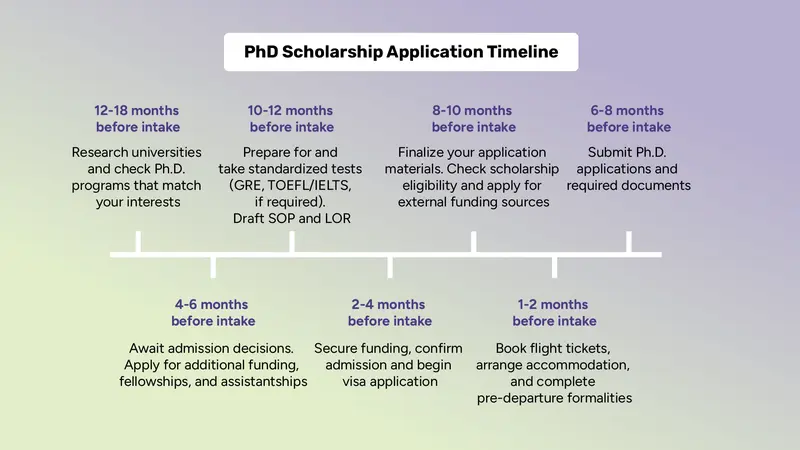
Here is the whole blog in one line: for a fully funded PhD in psychology in the USA, you do not win the money, you get admitted into it. Every strong move follows from that. You stop scattering applications across scholarships you cannot get, including celebrated ones like the NSF GRFP and Paul and Daisy Soros that are closed to Indian students outright, and you put that energy into landing a funded admission instead. That single shift is worth more than any scholarship list.
Aim for admission into a funded program, understand the funding gap between research PhDs and the PsyD, and treat financing as a precise gap-filler for the cases where funding genuinely falls short. If a real gap remains, GyanDhan can help you size a loan to exactly that gap, not the whole cost. Check your loan eligibility or speak to a study-abroad counsellor, at no charge.

No, according to the NSF GRFP eligibility page, applicants must be US citizens, nationals, or permanent residents, and foreign nationals on a student visa are explicitly listed as ineligible. There is no exception for F-1 students.
For the student, tuition is waived and a living stipend is paid, so you generally do not pay tuition and you receive money to live on. In return you work as a teaching or research assistant. It is best described as funded work toward a doctorate rather than something you pay for.
No, per USIEF, the Fulbright-Nehru Doctoral Research Fellowship funds 6 to 9 months of dissertation research in the US for scholars already registered for a PhD at an Indian institution, and its current cycle fields do not include psychology.
Both can lead to clinical licensure in the US, but most funded doctoral paths are PhDs, while most PsyD programs are unfunded and carry far higher debt. If cost is a major factor, a funded clinical PhD is the stronger financial choice, provided you can clear its highly competitive admissions.
Often not for tuition. A loan makes sense mainly for genuine gaps, such as living costs in an expensive city, an unfunded clinical or PsyD path, or bridge financing. Because assistantships and scholarships can count toward the loan margin under RBI's framework, a funded offer can significantly reduce how much you need to borrow.

Ask from a community of 10K+ peers, alumni and experts
Be the first to discuss this article
Ask a question or share your experience with students on GD Connect.
Add Your ResponseTrending Blogs
Similar Blogs

Network with a community of curious students, just like you
Join our community to make connections, find answers and future roommates..Country-Wise Loans
Best Lenders for Education Loan

ICICI Bank

Axis Bank

Union Bank

Prodigy

Auxilo

Credila

IDFC

InCred

MPower

Avanse

SBI

BOB

Poonawalla

Saraswat