



.webp)













Help our experts understand you better by filling our 2-Minute Form, to find the right education loan
Get instant loan offer suitable to your profile !


On this Page:
GIC Canada is no longer mandatory for a study permit, and the amount is now CAD 23,448. Here is what IRCC actually requires and which bank is fastest.

Quick Summary:
| What Changed | What It Means for You |
|---|---|
|
IRCC closed the Student Direct Stream in November 2024. |
A GIC account for international students in Canada is no longer mandatory for any visa stream. |
|
The proof-of-funds amount rose to CAD 23,448. |
This applies to applications submitted on or after September 1, 2026. The older CAD 22,895 figure expired on August 31, 2026. |
|
Quebec has its own, higher figure. |
CAD 24,617 as of January 1, 2026, separate from tuition and travel. |
|
No bank publishes a fixed GIC interest rate. |
Each sets your rate on the issue date, so fees matter more than rates when comparing banks. |
|
Refunds are not instant. |
Banks state up to four weeks, but High Commission verification and account mismatches stretch this further. |
|
Education loan funds do not always flow the way a GIC expects. |
Students funding their GIC account Canada deposit through a loan need to plan the fund route in advance. |
Most students searching for what is GIC in Canada are trying to answer one question: do I actually need this to get my study permit. IRCC closed the Student Direct Stream in November 2024, and that single change is the reason this answer looks different today than it did a year ago.
Getting this wrong has a real cost. IRCC's own data shows study permit approval rates fell to 41% for the January to September 2025 window, down from 51% over the same period a year earlier. Proof of funds sits at the center of that decision, which is exactly why getting this document right matters more than ever.

A Guaranteed Investment Certificate, or GIC, is an investment product offered by Canadian banks that returns your principal along with a fixed or variable rate of interest at the end of a set term. For international students, it functions as a way to show that funds are available to cover a year of living expenses in Canada.
A GIC for Canada account is not the same as a regular savings account. Three points separate it:


Until November 8, 2024, a Student GIC was a mandatory requirement under the Student Direct Stream, IRCC's fast-track processing option for applicants from a set list of countries including India. IRCC's own program review confirms the Student Direct Stream was cancelled in November 2024, citing integrity concerns and its effect on program diversification.
Once that stream closed, the GIC lost its mandatory status. IRCC's own guidance on proof of financial support lists a guaranteed investment certificate as one example among several accepted documents, alongside bank statements, proof of a student or education loan, and scholarship proof. There is no requirement that a GIC specifically be used.
So the answer to is GIC mandatory for Canada student visa in 2026 is no, but with a condition attached. IRCC still requires every applicant to prove access to the same amount of funds, regardless of which document is used to show it. A GIC for Canada student visa application remains one of the strongest ways to prove this, since it is a document Canadian visa officers recognize immediately and rarely question further. Bank statements, sponsor letters, and education loan sanction letters are also accepted, but each carries its own documentation burden, such as showing six months of account history with a clear source of funds, or evidence of the relationship between the applicant and a sponsor.
In practice, this is why many Indian students still choose to open a GIC account for international students in Canada, not because IRCC demands it, but because it closes this part of the application with a single document rather than a bundle of supporting evidence.
Three product types are commonly offered to international students, and the choice affects how much interest you earn, not whether your visa application is accepted.
For visa purposes, the product type does not matter. What matters is that the certificate confirms the required amount is held for the standard 12-month term.
The Canada student visa GIC amount has changed three times since 2024, which is why different sources quote different figures. IRCC raised the amount to CAD 20,635 for a single applicant outside Quebec, effective January 1, 2024, up from the previous CAD 10,000. It has since risen further. The current IRCC requirement stood at CAD 22,895 for applications submitted between January 1, 2025 and August 31, 2026, and now stands at CAD 23,448 for applications submitted on or after September 1, 2026. Both figures exclude tuition and transportation costs.
Quebec runs its own separate assessment, through its immigration ministry rather than IRCC's table. Under Quebec's current cost requirements, a single applicant must show CAD 24,617 to cover one year of basic needs, effective January 1, 2026.
The date IRCC receives your complete application decides which threshold applies, not your program start date and not the date on your offer letter. A file received on August 31, 2026 was assessed against CAD 22,895. The same file received on September 2 was assessed against CAD 23,448. This also applies to study permit extensions, judged by the submission date of the extension rather than your original arrival.
GIC Canada requirements beyond the amount itself are straightforward:
IRCC reviews this cost-of-living figure periodically against the Statistics Canada low-income cut-off, so a further revision around September 2027 for the following intake cycle is likely. Always confirm the current figure on canada.ca before transferring funds, since guides, including this one, can lag an official update by a few weeks.
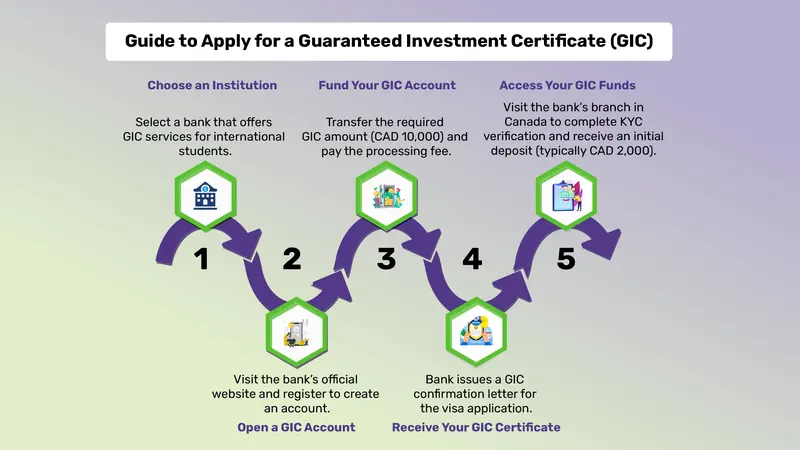
The process for how to open a GIC account in Canada is largely the same across participating banks, though the sequence of steps varies slightly.
The GIC Canada application process is designed to be completed from India, so a trip to a physical branch is not required at this stage. Most delays happen not during application, but during wire transfer, when a mismatch between the name on the passport and the name on the transferring bank account causes the payment to bounce back.
Rejected wires are the most common reason a GIC timeline slips, and the rules are stricter than most students realise.
SBI Canada Bank requires the sender and beneficiary names to match, and specifies that your bank's MT103 must carry your name, account number and full address on Line 50 and Line 59. Any mismatch and the funds go back.
Under SBI's Option A, the bank must receive the exact full amount with no deductions. If an intermediary bank shaves its charge off in transit, the transfer is returned rather than part-processed.
Funds sent through money exchange houses, transfer services, or from a friend's account are refused outright at SBI and ICICI Bank Canada. TD Canada Trust is the exception and accepts wires from family or friends. Every return costs you the intermediary fees and roughly two weeks, which is why the wire stage, not the application stage, is where students lose their intake.
Rate comparisons are the most common way these guides are written, and they are also the least useful, since no bank publishes a fixed GIC Canada interest rate for this program, and the spread on a 12-month term is small either way. The more relevant differences when picking the best GIC for international students in Canada are certificate turnaround time, fees, and country eligibility, particularly if your visa timeline is tight.
| Bank | GIC Amount (CAD) | Fees (CAD) | Certificate Timeline | Payout on Arrival | Countries Served |
|---|---|---|---|---|---|
|
SBI Canada Bank |
23,448 (Option A) or 1,000 to 50,000 (Option B) |
150, non-refundable |
About 1 business day after funds arrive |
4,948 upfront, then 18,500 over 12 months |
India, and other eligible countries |
|
TD Canada Trust |
23,448 |
No application fee |
Confirmation emailed once funds are invested |
8,448 upfront, then 1,500 monthly over 10 months |
26 countries including India |
|
Scotiabank |
5,000 to 50,000 |
200, covers application and wire processing |
Response typically within 24 hours of application |
Three options at branch, including monthly payouts |
19 countries including India |
|
ICICI Bank Canada |
As per current IRCC requirement |
200 processing + 25 for correspondent charges |
- |
Monthly payout or cashable GIC options |
India, and five other countries |
Note: Figures verified from each bank's official program page in September 2026. Interest rates are not listed because none of these banks publishes a fixed rate for this program. Confirm current terms before transferring funds.
Scotiabank allows a GIC from as little as CAD 5,000, and its own page places responsibility on the student to meet the IRCC threshold separately. A Scotiabank GIC does not automatically satisfy proof of funds. Open one at CAD 5,000 and you have a valid GIC certificate attached to an application that fails on funds.
Some student guides still list HSBC as a GIC account for international students in Canada. That option no longer exists. RBC announced it completed its acquisition of HSBC Bank Canada on March 28, 2024, bringing roughly 780,000 clients across, with former HSBC Canada branches operating as RBC locations from April 1, 2024. If a guide lists HSBC as a current GIC option, treat that source as outdated.
If your visa timeline is comfortable, the GIC Canada fees above are small enough that any of these four banks will serve you well. If you are closing this step against a tight deadline, certificate turnaround time matters more than the interest rate you earn over 12 months.
SBI Canada Bank requires the wire to come from an account held exclusively in your name or jointly with a parent or spouse, and explicitly rejects funds routed through third-party services. ICICI Bank Canada states the same, warning that funds from any other account will be returned. An education loan complicates this, since disbursement does not usually land in the student's personal savings account.
The standard fix is a two-account structure: a loan account in the applicant's name, and a joint savings account with the co-applicant. The bank's share moves from the loan account into the joint account, and the wire goes from there, keeping your name on both ends of the transfer.
Pre-visa disbursement matters here too. If your lender can release the GIC portion before your visa is approved, you avoid arranging funds at the last minute. Not every lender offers this by default, so confirm it before finalising who you borrow from.
Once you arrive in Canada, the bank does not release the full deposit in one transaction. A portion is released on arrival to cover immediate costs, and the rest follows in monthly installments. The upfront amount varies more than most students expect: SBI Canada Bank releases CAD 4,948 and TD releases CAD 8,448, a difference of roughly CAD 3,500 in your first weeks. If you are landing in Toronto or Vancouver, where first-month rent and deposit can clear CAD 3,000, that gap is worth checking before you pick a bank.
A non-cashable GIC cannot be accessed before maturity except through the refund process described below. A cashable GIC can be withdrawn earlier, usually after an initial lock-in period, though at a lower interest rate than the non-cashable option.
Two deadlines run quietly in the background. TD Canada Trust closes your chequing account if the wire does not arrive within 90 days of opening it, and closes both accounts and returns your funds if you have not completed the branch visit within 365 days. SBI Canada Bank requires account activation within 180 days of arriving in Canada. If you defer an intake, these clocks do not defer with you.
What GICs Do Not Cover?
A GIC proves you can support your living expenses. It does not replace tuition proof, and it comes with the same limitations as any fixed-term deposit.
Read also:

Refund timelines vary by bank, and each publishes its own. Scotiabank states a refund may take up to four weeks from the date a correctly completed refund application is received, and that any corrections required will delay it further. SBI Canada Bank also states up to four weeks, and notes that its refund is strictly subject to confirmation from the Canadian High Commission before processing begins. That confirmation step is what causes the published window to stretch in practice.
The two most common failure points:
To reduce the chance of this happening, confirm the exact refund process with your bank before initiating a request, keep a copy of every reference number issued, and avoid sending repeated follow-up emails that can create duplicate cases within the bank's system. For the complete refund process and required documents, see our detailed guide on GIC refund policy and timelines.
The GIC has quietly changed roles. It was mandatory under the Student Direct Stream, and it is now one option among several for proving you can fund your first year in Canada. What has not changed is the underlying test. IRCC still expects the full amount, currently CAD 23,448 outside Quebec, and still expects to see where that money came from. Quebec-bound students are assessed separately by the province, at CAD 24,617.
A GIC for Canada student visa application remains the cleanest way to meet that test, not because it is required, but because it answers the question in one document instead of a stack of statements. The decisions that actually cost students time and money sit further down: which bank you use, how your funds reach that account if a loan is involved, and what happens if the visa does not come through.
If you are funding your GIC alongside tuition and travel costs, GyanDhan can help you check your loan eligibility and confirm whether your lender supports pre-visa disbursement, so this step does not become a last-minute scramble.
You apply online through the bank's international student portal, wire the required amount from an account held in your own name, and receive an investment confirmation to submit with your study permit application. No branch visit is needed until you arrive in Canada.
No. It was mandatory only under the Student Direct Stream, which IRCC closed in November 2024. It remains an accepted and strongly recommended form of proof of funds, alongside bank statements and loan sanction letters.
CAD 23,448 for a single applicant outside Quebec, for applications submitted on or after September 1, 2026. This replaced the CAD 22,895 figure that applied until August 31, 2026. Quebec requires CAD 24,617 as of January 1, 2026.
Yes, but the fund route needs planning, since loan disbursements are typically routed through a loan and joint savings account structure rather than the applicant's personal account. Confirm this with your lender before initiating the transfer.
Banks state up to four weeks from a correctly completed request, though High Commission verification, mismatched account details, or untraceable wire transfers can extend this. Always retain every reference number the bank issues during the process.
No. A GIC is meant to prove funds for living expenses. Tuition should be planned for separately, since GIC disbursements follow a fixed monthly schedule that may not align with tuition deadlines.
Check Your Education Loan Eligibility

Ask from a community of 10K+ peers, alumni and experts
Be the first to discuss this article
Ask a question or share your experience with students on GD Connect.
Add Your ResponseTrending Blogs
Similar Blogs

Network with a community of curious students, just like you
Join our community to make connections, find answers and future roommates..Country-Wise Loans
Best Lenders for Education Loan

ICICI Bank

Axis Bank

Union Bank

Prodigy

Auxilo

Credila

IDFC

InCred

MPower

Avanse

SBI

BOB

Poonawalla
Saraswat