




.webp)









.webp)









Help our experts understand you better by filling our 2-Minute Form, to find the right education loan
Get instant loan offer suitable to your profile !

On this Page:
Looking for student loans for foreign higher education? Check this guide on available loan options and know how GyanDhan can help you in getting the best deal!

Planning to go abroad for higher studies but concerned about the sky-high tuition fees? Well, student loans for studying abroad will be the best option for you in this case. Keep reading to know the different student loan options available to you and which one is a better way to fund your higher studies abroad than using your personal funds.
Studies say that the cost of education is rising every year by 15%. Education has become expensive, be it in India or abroad. While a good education in India can cost you around INR 5 to 20 lakhs, students desirous of a foreign education have to shell more than INR 30 lakhs. In such a scenario, students who wish to study abroad have to dip into personal savings (either theirs or their parents’) such as fixed deposits, mutual funds, ULIPs, etc. But many do not have this financial cushion, and for them, study loans come as a blessing. Let us take a look at some of the reasons why loans are a better way to finance higher education abroad.

 Keep Your Savings Safe - Taking a student education loan will allow you to protect your savings such as MFs, FDs, ULIPs, retirement savings, etc. and use them to meet other expenses. Moreover, if you are a good investor, then you can invest your money and get higher returns and pay a part of it as an interest to the lender. Your savings can also be used to safeguard your education in future in case the program gets prolonged due to unforeseen events.
Get Income Tax Benefits - This is one of the most important benefits of opting for a student loan. Under Section 80E of the Income Tax Act of India, students who take an overseas education loan from a gazetted financial institution are eligible for deductions on the interest paid on the student education loan. This reduces the rate of interest to be paid. They can avail this deduction for up to 8 consecutive years and there is no upper limit on the amount to be claimed.
Build Your Credit Score - A student loan is one of the first methods through which a student can build his/her credit history. Timely repayment and compliance with the terms of repayment will help the student build a strong credit history which he/she can later use to his/her advantage for future funding needs.
Get the Benefit of the Moratorium Period - Repayment for secured loans begins after the moratorium period - which can be six months or a year after the program gets over. This gives students the chance to fully focus on their education during their study years instead of paying off their debts.
Easy Visa Approval - Visa authorities of most countries want to ensure that the flow of funds remains steady and that the funding source is reliable. At such a stage, student loans, especially from public sector banks help a student get easy approval for their visa as the regular flow of funds is assured and government banks are reliable.
Helps in Arranging Large Funds Upfront - Many countries such as Germany, Canada, Australia, etc., require students to show proof of funds for the entire intended duration or 1 year of their stay in the country, for which they have to pay the complete amount upfront. Paying such a large sum all at once becomes a burden on your pocket. In such cases, education loans help to alleviate this burden by bearing the entire amount and disbursing it directly to the university.
Provides a Safeguard Against Unexpected Expenses - Students who self-fund their education have to bear the additional expenses and arrange for extra funds in cases where they are hit by unexpected expenses. Students who take a student loan for abroad do not have to worry about unexpected expenses as they can request the bank to disburse the additional amount.
Keep Your Savings Safe - Taking a student education loan will allow you to protect your savings such as MFs, FDs, ULIPs, retirement savings, etc. and use them to meet other expenses. Moreover, if you are a good investor, then you can invest your money and get higher returns and pay a part of it as an interest to the lender. Your savings can also be used to safeguard your education in future in case the program gets prolonged due to unforeseen events.
Get Income Tax Benefits - This is one of the most important benefits of opting for a student loan. Under Section 80E of the Income Tax Act of India, students who take an overseas education loan from a gazetted financial institution are eligible for deductions on the interest paid on the student education loan. This reduces the rate of interest to be paid. They can avail this deduction for up to 8 consecutive years and there is no upper limit on the amount to be claimed.
Build Your Credit Score - A student loan is one of the first methods through which a student can build his/her credit history. Timely repayment and compliance with the terms of repayment will help the student build a strong credit history which he/she can later use to his/her advantage for future funding needs.
Get the Benefit of the Moratorium Period - Repayment for secured loans begins after the moratorium period - which can be six months or a year after the program gets over. This gives students the chance to fully focus on their education during their study years instead of paying off their debts.
Easy Visa Approval - Visa authorities of most countries want to ensure that the flow of funds remains steady and that the funding source is reliable. At such a stage, student loans, especially from public sector banks help a student get easy approval for their visa as the regular flow of funds is assured and government banks are reliable.
Helps in Arranging Large Funds Upfront - Many countries such as Germany, Canada, Australia, etc., require students to show proof of funds for the entire intended duration or 1 year of their stay in the country, for which they have to pay the complete amount upfront. Paying such a large sum all at once becomes a burden on your pocket. In such cases, education loans help to alleviate this burden by bearing the entire amount and disbursing it directly to the university.
Provides a Safeguard Against Unexpected Expenses - Students who self-fund their education have to bear the additional expenses and arrange for extra funds in cases where they are hit by unexpected expenses. Students who take a student loan for abroad do not have to worry about unexpected expenses as they can request the bank to disburse the additional amount.
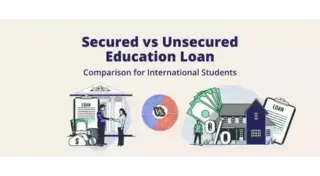
You must have understood why taking a student loan is better than self-funding. Now, let us throw some light on the different types of overseas education loans available for our readers. Basically, there are two types of student loans for studying abroad. They are - Secured Loans and Unsecured Loans. Let us discuss each one of them below.
Unsecured Student Loan - It is a student loan for which the borrower does not have to pledge any security (collateral). This loan is best for students who do not have any collateral to offer. However, it should be remembered that an unsecured education loan has a higher rate of interest (as against secured loan) and is more difficult to be approved. They also have a shorter repayment period and require certain repayments to be done during the study period too. Also, a minimum parental income is mandatory for this kind of education loan.
Secured Student Loan - A secured education loan is one where the borrower has to offer tangible or intangible security. The security can be in the form of immovable property, FDs, LIC insurance, land, etc. This kind of loan takes longer for approval as the bank has to verify all the documents related to the security being pledged. However, it has lower student loan Interest Rates, longer repayment period, and no repayment during the study period. This loan also has higher chances of approval and parental income is not aa deciding factor when it comes to approval.
Calculate Your Education Loan EMI
| Features | Public Banks | Private Banks | NBFCs |
|---|---|---|---|
|
Maximum Amount |
Only up to INR 7.5 Lakhs, which is not sufficient. |
INR 40 lacs |
INR 25 lacs |
|
Rate of Interest |
- |
11.25%-13% |
12%-14% |
|
Processing Charges |
- |
No fee for loan <20 lacs and INR 750 on each lac above a loan above INR 20 lacs |
- |
|
Number of Colleges Supported |
Although many colleges are eligible, PSUs don’t offer unsecured loans for higher amounts |
More than 200 |
More than 500 |
Repayment Tenure - People opting for unsecured student loans for studying abroad from private banks get 20 years to repay their loans. NBFCs give 10 years to the borrowers to repay the loan. Avail a customised foreign loan through us as we request the lenders for an extension in the repayment period on your behalf.
Processing Period - 5-7 days is what private banks need to process unsecured student loans. If the loan has been applied through GyanDhan, and there is a delay from the side of the lender, we contact them and quicken the sanction of loan.
Expense Coverage - If you opt for an unsecured loan from an NBFC, you can get 100% of your expenses covered, whereas, in the case of private banks, you can get 85% of your expenses covered. GyanDhan also makes sure that if a country requires you to show a specific amount in your bank account as proof of funds for a visa, that amount to is disbursed before visa.
Income Requirement of Co-applicant - Student education loans without collateral from private and public banks need the co-applicant to earn a minimum of INR 35,000 per month. The exact income requirement is subject to vary according to the loan amount. In our experience, typically, 50% of the income should be adequate to bear the interest during the moratorium period for loans from NBFCs and 65% of the income for loans from banks.
Reasons for Decline - A private bank or NBFC decline foreign studies education loan due to inadequate monthly income requirement and poor CIBIL score. However, you do have chances to secure an education loan even if your CIBIL score is weak. GyanDhan’s counsellor can come up with solutions for you to cross the hurdle and get your loan sanctioned.
| Features | Public Banks | Private Banks | NBFCs |
|---|---|---|---|
|
Maximum Amount |
upto INR 1.5 crore |
upto INR 60 lacs |
upto INR 50 lacs |
|
Rate of Interest |
8.85%-10.25% |
11%-13% |
12%-14% |
|
Processing Charges |
INR 11800 (Can be refundable) |
No fee for loan above INR 20 lacs and INR 750 on each lac above a loan of INR 20 lacs |
1%-2% loan amount |
|
Payment During Study Period |
None |
Simple Interest |
Simple Interest |
Repayment Tenure - There is a 15-year repayment tenure for overseas education loan from public banks. For NBCFs, it is 10 years, and for private banks, it is 20 years.
Processing Period - It takes public banks 12-15 days (only if applied via GyanDhan, otherwise can take months) to process student education loans with collateral and 8-10 for private banks. NBFCs manage to get the loans processed in 5-7 days.
Expense Coverage - There is a 90%-100% coverage of the costs including living expenses in the case of loans from public banks, but private banks cover only 86%. Loans from NBFCs offer 100% coverage of expenses.
Reasons for Decline - The common reason why a public bank will decline a secured loan is incomplete collateral documents. Incomplete documents and low CIBIL score are the reasons which private banks cite for rejecting loans. For NBFCs, CIBIL and low income lead to the rejection of loans.
With GyanDhan, you can increase your chances of getting your loan sanctioned by 50%. Our team does a thorough analysis of your profile and funding requirements and suggests you only that lender which is most likely to get your loan approved.
Apply Education Loan
Given below is the list of documents commonly required for an education loan. However, the specific documents required vary as per different cases. Documentation is indeed a cumbersome and time-taking process, and this is exactly what GyanDhan aims to ease. As per the loan opted by you, we generate a list of customized documents via a tool which needs to be submitted, thus streamlining the process and saving your time and effort.
| Education Loan with Collateral | Education Loan without Collateral |
|---|---|
|
|
Majority of the lenders offer student loans for studying abroad for the most popular courses in foreign countries. For the benefit of our readers, we list down some loan options for popular course-country combinations:
MBA is one of the most sought after programs among Indian students who plan to go abroad.
If you want to get a loan for studying an MBA in the USA, read about your overseas education loan options here.
If Canada is your destination country for an MBA, know about different student education loan options here.

Check Your Education Loan Eligibility

Ask from a community of 10K+ peers, alumni and experts
Published date: 04 Feb 2020 Updated on: 06 Apr 2020 Planning to go abroad for higher studies but concerned about the sky-high tuition fees? Well, student loans for studying abroad will be the best option for you in this…
1 reply from the GD Connect community · last active about 6 years ago
Trending Blogs
Similar Blogs

Network with a community of curious students, just like you
Join our community to make connections, find answers and future roommates..Country-Wise Loans
Best Lenders for Education Loan

ICICI Bank

Axis Bank

Union Bank

Prodigy

Auxilo

Credila

IDFC

InCred

MPower

Avanse

SBI

BOB

Poonawalla
Saraswat