



.webp)







.webp)








Help our experts understand you better by filling our 2-Minute Form, to find the right education loan
Get instant loan offer suitable to your profile !

On this Page:
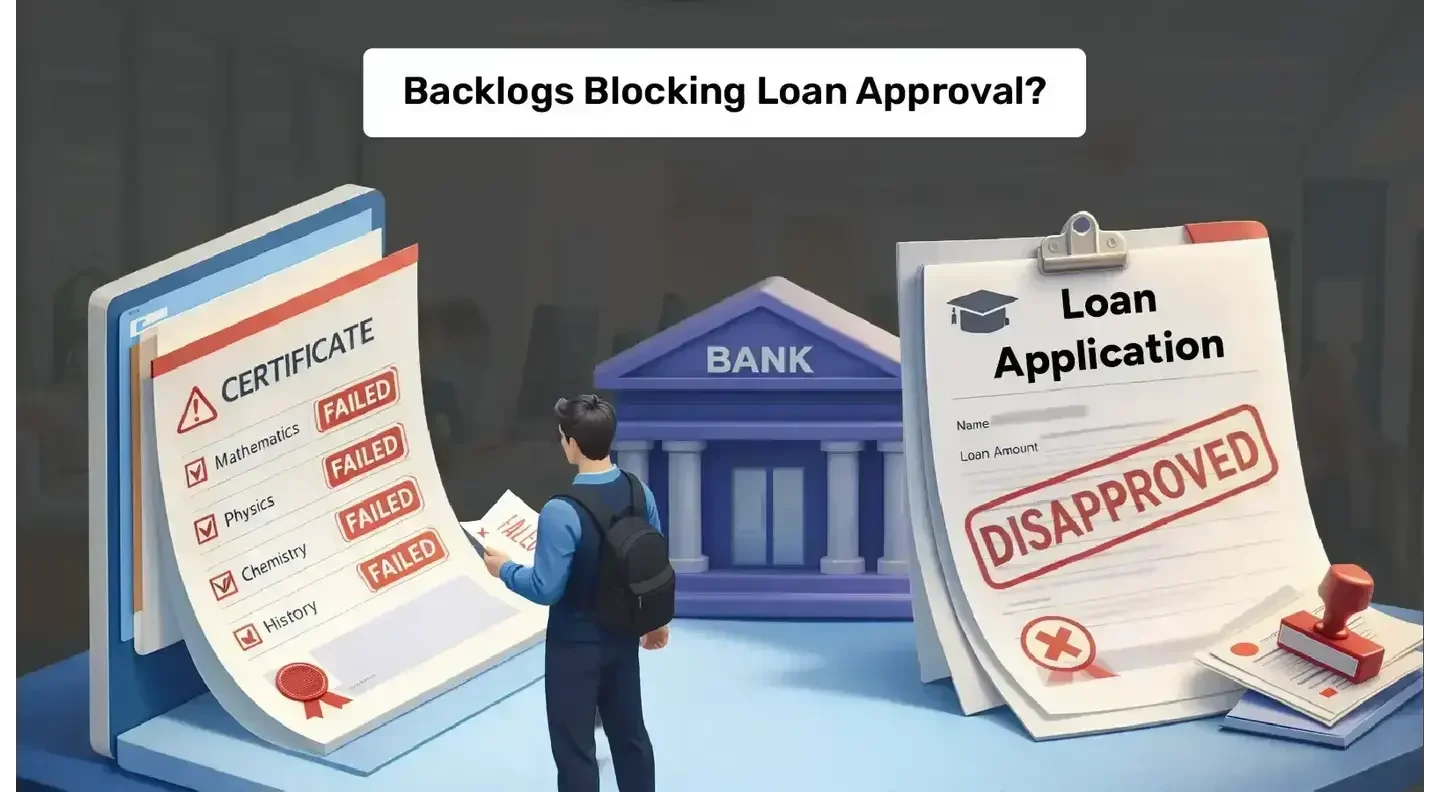
Facing education loan rejection due to backlogs? Learn why loans get rejected, whether you can still get a loan and how to improve your approval chances for study abroad.

Quick summary:

Academic backlogs are often seen as a major hurdle when applying for an abroad education loan. That said, when an education loan gets rejected over backlogs, academic performance is rarely the only reason. And that distinction matters. If backlogs alone decided loan approvals, approval rates would simply mirror academic performance. Instead, the data tells a different story. India's education loan market is holding up well, even as banks have gotten pickier about who they lend to. That's the real story buried in a recent Ministry of Finance report. Gross NPAs on education loans at public sector banks dropped from roughly 7 percent in FY 2020-21 to about 2 percent in FY 2024-25 — a sharp cleanup in asset quality over just four years.
Layer the PM Vidyalaxmi scheme on top, and the picture gets even more interesting. It's built to make collateral-free loans available to students who get into any of India's top 860 higher education institutions. On paper, that's a pool of more than 22 lakh students a year who could benefit.
These trends show that lenders remain willing to finance higher education, but approval still comes down to meeting their credit and risk criteria. And a backlog on your transcript is one of the things that can count against you. This guide explains why loan applications get rejected, how lenders assess backlogs, and the practical steps you can take to improve your approval chances.

A loan rejection due to backlogs does not mean banks have a blanket policy against students with backlogs. It usually means the lender assessed the full application and judged the lending risk to be higher than what its internal credit policy allows.
Contrary to popular belief, neither the RBI nor the Indian Banks' Association (IBA) has any guideline that makes students with backlogs automatically ineligible. Under the IBA Model Education Loan Scheme, banks are expected to frame their own board-approved lending policies.
As a result, two students with near-identical academic records can end up with completely different outcomes.
Take a student with four cleared backlogs. He also has an admission from Purdue University for an MS in Computer Science, competitive GRE scores, and a financially strong co-applicant. The backlogs are real. But so is everything else. And often, everything else wins. The loan gets approved because the overall profile signals strong employability and solid repayment potential.
Now flip the script. A different student has just one active backlog — fewer than the first, on paper. But the admit is from a lower-ranked university, and the co-applicant's financial profile is weaker. This is the application that's more likely to be rejected. Not because of the backlog itself, but because the lender sees more uncertainty about whether the course will be completed, and whether the loan will come back.
At the end of the day, lenders do not read backlogs in isolation. They read the whole file.

One of the biggest misconceptions among students is that lenders decide on an education loan application based solely on the number of backlogs. In practice, that's rarely the case. During the underwriting process, lenders are often more concerned with whether the backlogs are still active or have already been cleared. In fact, an applicant with four cleared backlogs may present a lower credit risk than someone with just one unresolved backlog.
The reason is straightforward. Education loans are sanctioned against a student's future earning potential, not their current income.
An active backlog introduces uncertainty into that future. It raises questions. Will the student finish the course on time? Could graduation or visa timelines slip? And ultimately, will repayment start when it's supposed to?
A cleared backlog, on the other hand, shows the student ran into a setback, faced it head-on, and still met what the programme required. It stays part of the academic record, but it's generally seen as a sign of recovery rather than an ongoing concern.
Although lenders do not publish fixed eligibility criteria for the number of acceptable backlogs, applications are generally assessed along the following risk spectrum:
| Academic Profile | Typical Underwriting View | Overall Risk |
|---|---|---|
|
0 active backlogs |
Shows academic continuity with no concerns. It generally has the strongest approval prospects. |
Low |
|
1 active backlog |
This needs closer review. Approval depends on the university, course, co-applicant profile, and the reason for the backlog. |
Moderate |
|
2–3 active backlogs |
This signals a possible delay in course completion. It draws more scrutiny, especially from public sector banks. |
High |
|
Cleared backlogs only |
This shows academic improvement and reduces uncertainty. The focus shifts to employability and repayment capacity. |
Moderate to Low |
|
4+ cleared backlogs |
Approval is still possible for good universities and employable courses. It depends on the lender's policy and the co-applicant’s strength. |
Profile Dependent |
Ultimately, lenders look at the trajectory, not just the setbacks along the way. A student who cleared his backlogs, got into a recognised university, and shows strong repayment potential may actually fare better than one with fewer, unresolved deficiencies still hanging over him. The count does not decide the outcome. The overall credit profile does.
With lenders having the flexibility to frame their own board-approved credit policies, the study abroad education loan approval criteria vary across institutions. However, most lenders evaluate the following factors before approving an education loan with backlogs.
Put simply, an education loan rejection over backlogs is almost never about academics alone. It's the outcome of a much wider risk assessment — one where lenders weigh the academic record alongside financial strength, employability, and the likelihood of repayment down the line.
One of the biggest myths among students is that all lenders have the same criteria when they evaluate education loan applications. In fact, there is no standard industry rule on how many backlogs are OK.
The IBA Model Education Loan Scheme provides broad operational guidelines to the banks but permits them to evolve their own lending policies subject to approval by their boards. As a result, the same applicant may receive different lending decisions depending on the institution's risk assessment framework.
| Lender Type | How They Evaluate Backlogs | What They Prioritise | Best Suited For |
|---|---|---|---|
|
Public Sector Banks (PSBs) |
Apply a structured credit appraisal process generally. Active backlogs are generally more scrutinised but cleared backlogs may be accepted if the academic and financial profile is strong |
Academic consistency, Recognised universities, Employability of course, Co-applicant strength, Repayment capacity, Collateral (where applicable). |
Students with strong academic backgrounds, admission offers from top schools and good financial support. |
|
Look at applicants in the round, including their academic record, as well as their financial and career considerations. Backlogs are viewed in the context of the overall applicant profile, not as a separate issue. |
University reputation, employability of the course, earning potential in future and financial security. |
Students with moderate academic gaps, but with good career prospects and a strong admission profile. |
|
|
They tend to be more holistic and flexible, looking at the full student profile and not just academic history. |
Destination country, university, employability, future income, co-applicant profile, and overall repayment potential. |
Students seeking an education loan with backlogs or a study abroad loan with backlogs, particularly after being declined by traditional banks. |
At the core, lenders want to know one thing: will this student finish the course, get a job, and repay the loan on time? Backlogs alone do not answer that question. If the rest of the profile, including academic, financial, and career, holds up, an applicant can still get approved despite them.
Where a student plans to study matters too — often more than people realise. Lenders do not just look at tuition costs. They weigh graduate employment prospects, post-study work options, and the overall return on investment a country offers.
The US keeps earning lender confidence, and it's not hard to see why. According to the 2024 Open Doors Report, more than 3.3 lakh Indian students were enrolled at U.S. institutions during the 2023–24 academic year, making India the largest source of international students. Globally recognised universities, especially in STEM, and graduate salaries that hold up well. Students in eligible STEM programmes may also qualify for an extended Optional Practical Training (OPT) period, which only sweetens the post-study employment picture. For an applicant with backlogs, the right combination — a reputed university, solid GRE scores, a technically oriented course — can be enough to carry the application through.
Canada remains a preferred pick, largely on the back of its established higher education system and its post-graduation work opportunities. The Post-Graduation Work Permit (PGWP) lets eligible graduates build Canadian work experience right after their studies, which helps long-term employability. Lenders tend to favour applicants heading into PGWP-eligible programmes at recognised institutions. Pair that with cleared backlogs, a strong IELTS score, and a steady academic record, and the repayment profile starts looking pretty reassuring.
Business, finance, healthcare, engineering, law — Indian students keep choosing the UK across the board. Nearly 100,000 Indian study visas were granted in the year to June 2025 alone. Part of the draw is the Graduate Route, which lets eligible graduates stay back and work once they've finished their degree, giving their careers a head start. What do lenders actually care about here? Not much changes: a recognised university, an employable programme, and a repayment strategy that holds together — that matters even more when there's a backlog in the picture.
Public universities. Low tuition. An engineering ecosystem that's genuinely hard to beat elsewhere. That's what Germany has to offer, and it works on lenders too. Graduates can also stay back to search for skilled employment after finishing their studies, which only strengthens the repayment outlook. So if an applicant has backlogs but they're cleared, and they're headed into a recognised technical university for an engineering or tech-focused programme, they tend to do well here.
Globally recognised universities, real post-study work opportunities — Australia has held its spot as a top destination for a reason. Lenders typically assess the university's reputation, total cost of education, and employment prospects after graduation. Strong English language proficiency, academic improvement, and a financially stable co-applicant can improve approval prospects for students applying with previous backlogs.
An education loan rejection due to backlogs does not necessarily mean the end of your study abroad plans. Take the case of a student who came to us because a bank turned down his loan application. The reason was the same — three pending backlogs in the final year of engineering. But as the student had already secured admission to a well-ranked and strong graduate employability university in Australia, the rejection seemed like the end of his dreams. His backlogs had made the lender wary of repayment risk.
So, to improve his education loan approval chances, he was first advised to clear his outstanding backlogs before reapplying. As he had already cleared IELTS with a competitive score, he now had something to support his academic consistency.
Since the loan amount required exceeded the collateral-free limit under CGFSEL, the family agreed to offer property as collateral. This also strengthened the lender's confidence considerably. A parent, a salaried professional with a stable income and clean credit history, was added as a co-applicant, further reinforcing repayment capacity.
Now, when he was reapplying to get the loan, he was advised not to go to multiple lenders at once. We helped him match the profile with a lender better suited to his academic and financial profile. This was made possible by our network of 1800+ lending partners and experience serving over 35,000 students. He was able to get the loan sanctioned within two weeks, and he joined the university on schedule.
One insight that we have got after working with thousands of students at GyanDhan is that documentation often matters as much as the academic profile itself. We've noticed that applications are delayed more often because supporting documents are incomplete than because of the backlog. Students who proactively submit updated academic records, proof that their backlogs have been cleared, and a complete financial profile generally face fewer follow-up queries during the application process.
Lender policies explain one side of the story. What we've observed after reviewing thousands of education loan applications explains another. Interestingly, many of those same patterns also appear in discussions across Quora and study-abroad forums. While these experiences do not represent official lending criteria, they closely mirror how lenders assess applications in practice.
One pattern stands out consistently. Students often assume that a single backlog is enough to trigger rejection. But what we’ve experienced is that it's rarely the deciding factor. Applications with cleared backlogs, admission to recognised universities, and financially strong co-applicants are often approved.
The same pattern shows up in student discussions online. Many borrowers with multiple cleared backlogs report securing funding despite their academic history. What changed was their strong GRE or IELTS scores, admission to a recognised university, and a financially stable co-applicant.
Another pattern we've consistently seen is lender selection. Students rejected by one lender often receive approval from another. That’s only because of the lender's risk assessment framework. Experienced borrowers recommend improving the application first and then applying to lenders whose eligibility criteria better match their profile.
Taken together, both our experience and student discussions point to the same conclusion: education loan rejection due to backlogs is rarely about the backlog alone. More often, it reflects how lenders assess the applicant's overall academic, financial, and repayment profile.
Here's the reality: for many students, backlogs are not what ultimately determine whether an education loan gets approved. Treating them as the sole reason for rejection oversimplifies how lenders actually assess risk.
An active backlog may raise concerns about course completion, but a cleared backlog tells a different story. Combined with admission to a recognised university, an employable course, a financially strong co-applicant, and a well-prepared application, a backlog does not automatically prevent you from securing funding. The real question for lenders has little to do with a failed subject somewhere in your past. It's about whether you'll finish your education, build a stable career, and eventually pay back what you owe. Which means strategy matters here just as much as your profile does.
So before submitting an application, take time to understand your education loan eligibility. Identify lenders whose credit assessment actually aligns with your profile. Then address the factors most likely to influence the decision.
Not sure whether your academic record could affect your application? GyanDhan's experts can help. They'll assess your profile, match you with lenders suited to your case, and guide you through the documentation and application process.

Yes, it is possible. Lenders usually check whether the backlogs are cleared, how many there were, and whether your overall academic performance improved afterwards. Backlogs alone do not automatically mean rejection.
Banks will not typically halt an education loan over a single backlog. That said, disbursements can get paused if the backlog costs you your regular student status, pushes your course beyond its standard duration, or breaches a specific academic clause in your loan agreement.
If your education loan was declined over credit or income concerns rather than the backlog itself, adding a stronger co-applicant can help. Since students rarely have credit histories of their own, a financially sound co-applicant's income and credit profile can offset those concerns.
Most lenders recommend waiting three to six months before reapplying. This time is best used to clear pending backlogs, strengthen your academic record, build up your co-applicant's profile, or find a lender better suited to your situation.
If your education loan gets rejected, first you need to know the main reason behind the rejection. Once you have that, try to fix it. For example, if it is rejected due to a high number of backlogs, try to reduce your active backlogs.
Check Your Education Loan Eligibility

Ask from a community of 10K+ peers, alumni and experts
Be the first to discuss this article
Ask a question or share your experience with students on GD Connect.
Add Your ResponseTrending Blogs
Similar Blogs

Network with a community of curious students, just like you
Join our community to make connections, find answers and future roommates..Country-Wise Loans
Best Lenders for Education Loan

ICICI Bank

Axis Bank

Union Bank

Prodigy

Auxilo

Credila

IDFC

InCred

MPower

Avanse

SBI

BOB

Poonawalla
Saraswat