



.webp)









.webp)


















Help our experts understand you better by filling our 2-Minute Form, to find the right education loan
Get instant loan offer suitable to your profile !

On this Page:
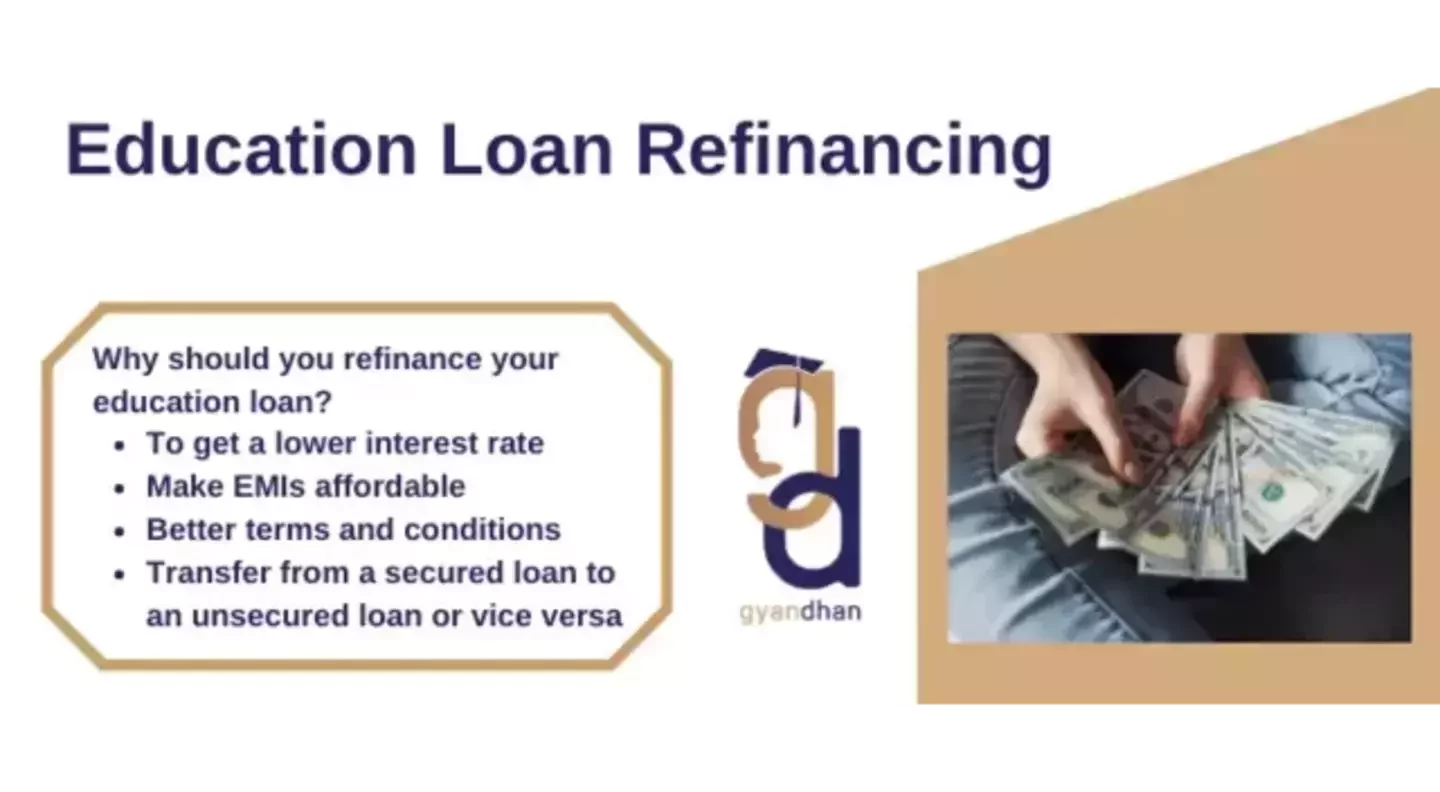
Education loan refinancing explained: how to transfer your loan to another bank, eligibility, balance transfer process, savings and when it's worth it.

Quick Summary:
| What to Know | What It Means for You |
|---|---|
|
No foreclosure charges on floating-rate loans, including loans taken before 2026. |
Most education loan borrowers can move lenders without an exit penalty, not just those who signed after January 2026. |
|
The switch is worth it above a 1% to 1.5% rate gap. |
A smaller gap gets eaten by processing fees. |
|
Banks rarely accept transfers below INR 10 lakh outstanding. |
Small balances usually cannot save enough to justify the move. |
|
A transfer is a fresh underwrite, not a formality. |
750+ CIBIL and a clean repayment record decide your new rate. |
|
NBFC to public bank is the highest-value switch. |
This is where the rate drop is largest. |
|
Lower EMI is not the same as lower total interest. |
A longer tenure can raise what you pay overall. |
|
USD refinancing is a separate path for earners abroad. |
Lower rate, but you take on currency risk. |
Outbound student numbers have been falling, not rising. According to the Ministry of Education's reply in Rajya Sabha, based on Bureau of Immigration data, the number of Indian students who went abroad for higher education dropped from 9.08 lakh in 2023 to 7.7 lakh in 2024, and further to 6.26 lakh in 2025, a decline of nearly 31% over three years. Fewer students are going abroad, but that has little bearing on the students already repaying loans taken in 2022 or 2023, often at rates fixed in a hurry at admission time.
That is where education loan refinancing and education loan transfer come in. You are not locked into the rate you started with. You can move your loan to a cheaper lender, and under RBI's consolidated 2025 rules, the exit penalty that used to make switching expensive no longer applies to most floating-rate education loans, whichever year you took yours. This guide covers the process, the eligibility reality, the RBI rule that rewrote the economics, and when switching saves lakhs versus when it quietly costs you more.

In simple terms, student loan refinancing means taking a new loan at a new interest rate to pay off your existing education loan. The same move is called an education loan transfer, an education loan takeover, or an education loan balance transfer. They all describe one thing: your new lender clears the outstanding principal with your current lender, and you start a fresh loan.
The usual trigger is a loan secured in a hurry from a private lender or NBFC at a high rate at admission time. Once you graduate and start earning, that rate feels expensive, so you switch to better terms. Most Indian lenders, including public banks, private banks, and NBFCs, accept transfers.

This is the most important development for refinancing education loans, and most guides have it half right.
RBI first issued the Pre-payment Charges on Loans Directions in July 2025, barring lenders from levying foreclosure or prepayment penalties on floating-rate loans taken by individuals for non-business purposes. Almost every article written since has reported the same takeaway: the protection applies only to loans sanctioned or renewed on or after 1 January 2026, and borrowers who signed earlier are stuck with their original agreement.
That reading is now incomplete. On 28 November 2025, RBI consolidated its entire regulatory rulebook, issuing 244 Master Directions and withdrawing 9,445 individual circulars whose content had either been absorbed into the new Directions or become redundant (Consolidation of Regulations, RBI/2025-26/100). The July 2025 prepayment circular was one of those withdrawn, and its provisions moved into the Responsible Business Conduct Directions, 2025, issued separately for each category of lender.
The consolidated text splits the rule in two, and the first half is the part that matters for anyone already repaying a loan:

An education loan to a student is a non-business loan to an individual. So if you took a floating-rate education loan in 2021, 2022, or 2023 and have been told your original agreement binds you to a foreclosure charge, the consolidated Directions say otherwise. Far more existing borrowers can exit penalty-free than the internet currently tells them.
Fixed-rate loans stay outside this, so check your Key Facts Statement. Terms like Repo Linked, EBLR, or Floating Rate confirm you qualify. Where it applies, it is unconditional. The Commercial Banks Responsible Business Conduct Directions, 2025, governing SBI, ICICI, Axis, and PNB, bar the charge whatever the source of your funds, in part or in full, with no lock-in. Equivalent provisions cover NBFCs like Credila, Avanse, and InCred.
The practical effect on your decision is straightforward. The toll that lenders once collected for letting you leave was 1% to 4% of outstanding principal at many private lenders and NBFCs. For most floating-rate education loans that toll is now zero, which means the only real question left is whether the rate gap justifies the paperwork.
Most students underestimate how large the interest difference can be. Take an example. You took an education loan of INR 20 lakh at 12%, repayable over 9 years including a 2-year study period. The interest works out to roughly INR 19,68,553. Refinance the education loan with a lender offering 10% on graduation, and over the remaining 7 years the interest payable falls to about INR 11,39,007. The difference is INR 8,29,546.
Apart from a lower rate, some borrowers refinance a secured loan into an unsecured one, which frees up the pledged property and eases the burden on the family member who provided collateral.
Note what is doing the work in that example. Part of the gap comes from the lower rate and part from the shorter remaining tenure, which is why the next point matters.
There is a trap inside this math, though. A lower EMI is not the same as lower total interest. If you refinance and stretch the tenure to bring the EMI down, you can end up paying more interest overall, because you are paying it for more years. The saving is real only when the rate drop outweighs any tenure extension, so compare total interest payable across the full remaining tenure, not just the EMI the new lender quotes.
The savings example above shows the headline number. What it does not show is that a rate drop is only one of several things a switch can buy you, and for some borrowers the collateral or the tenure matters more than the interest. Here is what a student loan refinance actually puts on the table:
The strongest time to opt for education loan refinancing is after you start working. A steady job lowers the lender's perceived risk, improves your negotiating position, and lets the new bank assess your income directly. Beyond timing, a switch makes clear sense when:
An education loan transfer looks like a one-way win because the pitch is always framed around the rate you save. The cost side is quieter, and it shows up when:
Run the net number before you move. Interest saved from the lower rate, minus the processing fee, minus any interest added by a longer tenure. If that figure is not comfortably positive, staying put is the smarter call.
Students often assume a transfer is a formality. It is not. The new lender underwrites you from scratch, and transfers do get rejected. To qualify, you generally need:
Working professionals with an existing student loan are also eligible for an education loan takeover, and salaried income often strengthens the application.
The process to transfer an education loan to another bank follows four steps:
Step 1: Approach your current lender and request a foreclosure or final settlement statement showing the exact outstanding principal and interest.
Step 2: Apply to the new lender for an education loan refinance, and arrange the required documents.
Step 3: Once approved, the new lender pays the outstanding amount directly to your current lender.
Step 4: After the payment clears, the current lender forecloses the loan and releases your original documents.
The operational details around these steps are where borrowers lose money:
The four steps look similar everywhere, but execution varies between secured and unsecured loans, and between public and private lenders:
Across lenders, unsecured loans transfer faster and with less paperwork than secured ones.
Here are the documents typically required for an education loan balance transfer:
For secured loans, the collateral and property documents form an additional set that moves only after the lien-release process is complete.
Eligibility gets you approved. The terms decide what the loan costs and what the new lender holds against it, and an education loan takeover can quietly change both. Here is what applies:
Read more about: Transferring Your Education Loan: How and When to Do It

For students who studied abroad and now earn in dollars, there is a second path: refinancing your Indian loan into a USD loan with a specialised overseas lender. This is a different decision from a domestic transfer.
It can make sense when you are settled in a job in the destination country, earning in the local currency, and want repayments in that same currency. A USD refinance can lower the rate for strong-credit borrowers, remove foreign-exchange conversion costs on every EMI, and build local credit history. Some lenders also allow you to release an Indian co-applicant or collateral.
The caveat is real. Moving repayment into a foreign currency introduces exchange-rate risk, and if your income situation shifts, currency movement can raise your effective cost. Whichever way you go, close the Indian loan properly. Collect the No Objection Certificate, retrieve any collateral documents, and confirm the lien is removed from your CIBIL record.
Not every case is an abroad loan. Borrowers who took a loan for study within India, and working professionals servicing an education loan, can transfer too, but the math tilts differently.
Domestic loan amounts are often smaller, so the INR 10 lakh threshold bites harder and a modest balance may be too small to interest a new lender. Section 80E still applies and the public-bank tenure advantage still holds, but because the absolute saving on a smaller balance is lower, education loan refinancing in India only justifies itself when the rate gap clearly beats the processing cost.
By this point the decision is narrow. These four checks are what separate a student loan refinancing move that pays from one that only looks like it does:
Across the 35,000+ students GyanDhan has advised on education financing and the INR 11,000+ crore in loans facilitated, the pattern is consistent: the borrowers who benefit most are not the ones chasing the lowest headline rate, but the ones who run the full net-savings number before they move.
The question around education loan refinancing has changed. It is no longer whether you can switch, because for most floating-rate loans, RBI's consolidated 2025 Directions have removed the exit penalty that stood in the way, whichever year you borrowed. The question now is whether the net math clears the friction. Does the rate drop, after fees and any tenure effect, leave you better off?
For borrowers stuck at high NBFC rates early in repayment, with a strong CIBIL profile, the answer is often a clear yes worth lakhs. For those late in the tenure, on small balances, or tempted by a lower EMI hiding a longer loan, the answer is sometimes no. If you are weighing a transfer, GyanDhan works with 20+ lenders and can help you model your case before you commit. Check your education loan eligibility now.
Yes. Borrowers commonly transfer to secure a lower rate or better terms. The new lender clears your outstanding balance with the current lender and starts a fresh loan.
For a floating-rate education loan taken by an individual for non-business purposes, no. RBI's consolidated Responsible Business Conduct Directions, 2025 bar prepayment charges on such loans, with separate provisions covering loans sanctioned before 31 December 2025 and those sanctioned or renewed on or after 1 January 2026. Fixed-rate loans remain outside this protection, so check whether your sanction letter says Repo Linked, EBLR, or Floating Rate.
If it is floating-rate, no. The Directions carry a separate provision for existing floating-rate term loans sanctioned before 31 December 2025, so a 2022 loan is covered even though it predates the January 2026 date most articles cite. If your closure statement still shows a charge, raise it in writing.
SBI's takeover rates apply to balances above INR 10 lakh, and most lenders set a comparable floor. Below that, the saving often does not justify the process.
In many cases yes, since several lenders no longer require you to finish the course first. But a transfer within the first six months of the initial disbursement is generally not advisable.
The new lender runs a credit check, which can cause a small, temporary dip. Timely payments on the new loan restore and improve the score over time.
Usually yes, so repayment does not start immediately after the takeover. Confirm with the new lender, since terms vary.
Check Your Education Loan Eligibility

Ask from a community of 10K+ peers, alumni and experts
Be the first to discuss this article
Ask a question or share your experience with students on GD Connect.
Add Your ResponseTrending Blogs
Similar Blogs

Network with a community of curious students, just like you
Join our community to make connections, find answers and future roommates..Country-Wise Loans
Best Lenders for Education Loan

ICICI Bank

Axis Bank

Union Bank

Prodigy

Auxilo

Credila

IDFC

InCred

MPower

Avanse

SBI

BOB

Poonawalla

Saraswat