




.webp)










.webp)
.webp)



Help our experts understand you better by filling our 2-Minute Form, to find the right education loan
Get instant loan offer suitable to your profile !

On this Page:
Know the various types of collateral that can help secure your education loan. Learn different types of collateral and conditions to get your education loan with ease.

Collateral refers to an asset or property that a borrower pledges to a lender as security for a loan. It serves as a form of protection for the lender in case the borrower defaults on the loan or fails to fulfil their obligations.
When obtaining a loan, the lender may require collateral to mitigate the risk associated with lending money. If the borrower is unable to repay the loan, the lender can seize the collateral and sell it to recover the outstanding balance. A loan where security is required is termed a secured loan.
A secured loan is easier to get sanctioned, as the bank views the collateral as a security that can be used in case the borrower fails to repay the loan or the loan becomes a Non - Performing Asset (NPA). In the case of a secured loan, (loan with collateral) the loan amount sanctioned depends on the value of the collateral that is pledged with the loan.
Check Your Education Loan Eligibility

| Description | Public banks | Private banks | NBFCs |
|---|---|---|---|
|
Loan amount |
Up to INR 2 Cr. |
Up to INR 80 Lakh |
Up to INR 80 Lakh |
|
9.40% - 10.90% |
11% - 12.75% |
12% - 14% |
Borrowers can basically pledge two types of collateral, when applying for a secured education loan. They are as follows:

Tangible assets include real estate assets such as houses, flats, etc. Kindly note that agricultural land or land that falls under the jurisdiction of gram panchayat is not accepted as collateral by lenders. However, non-agricultural open land that has clear boundaries is accepted as collateral for secured education loans.
Intangible assets:
Intangible assets include liquid securities such as fixed deposits, mutual funds, ULIPs, Life Insurance policies, government bonds, etc. Borrowers can pledge an old or open a new fixed deposit for an education loan. However, the fixed deposit holder will continue to get any interest received on these intangible assets.
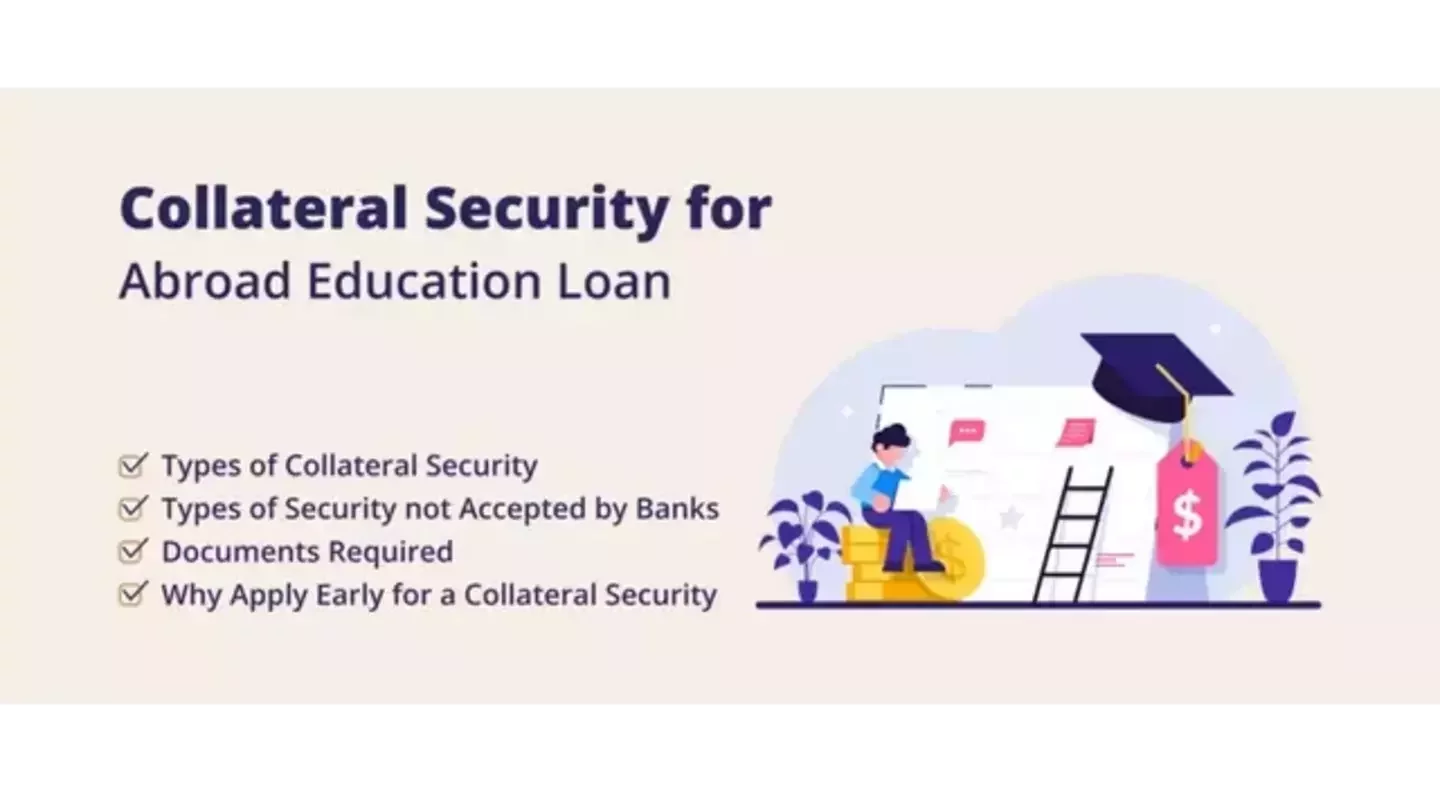
Banks generally accept the following types of collateral for an abroad education loan.
Residential property
Fixed deposits
Government bonds
Insurance policies
Open land with boundaries
Lenders generally do not accept the following immovable properties:
Agricultural land
Open land without boundaries
In Telangana: Notary registered property
In Karnataka: B Khata property
In Delhi: GPA or leasehold properties
If the property you want to pledge fulfills the bank's eligibility criteria then you can use it as collateral. Using a collateral that is not located in the city you live is possible and such instances are commonly referred to as Multi-city cases and are typically approved by most banks.
To pledge an asset located in a different city, require bank branches to coordinate with each other. The branch handling the paperwork sends a request to the branch nearest to where the property is located.
Read More About: Education Loan with Backlogs
This is a common concern among students who have secured their education loans with collateral. There is often a misconception that missing a single EMI payment will lead to the immediate seizure of pledged collateral. However, that is not true. Banks provide borrowers with ample time and opportunities before actually taking possession of the collateral.
The list of documents required for collateral, depends on several factors, primarily: property type, purchase history, and location. Broadly, the following documents are required:
Common documents:
Registered sale deed
Approved plan or map of the constructed property
Chain documents, evidencing the ownership history of the property for the last 30 years.
Latest property tax receipt.
Occupancy proof
Property title deed
Original registration receipt for the above agreement
Allotment letter by the municipal corporation/authorized govt. authority such as MHADA, CIDCO, HUDA, DDA, JDA, GIDC, etc
Previous chain of sale deed establishing title.
Most recent property tax bills or electricity bills having the same address.
Approved plan/map if the property being pledged is a built one.
Link documents that prove the ownership history of the said property for the previous 30 years.
A latest property tax receipt
Check Your Education Loan Eligibility
Additional documents if you’re applying for an education loan with a property in the following cities:
Mumbai or Pune
NA order
Urban land ceiling order
NOC from a builder or society
Share certificate
Letter of allotment
Conveyance deed of society
If CIDCO / MHADA property: NOC and transfer letter
Hyderabad
Urban land ceiling certificate
NA certificate, if not included in the sale deed
7/12 extract, if not included in the sale deed
Encumbrance certificate
Bengaluru
RTC (Record of tenancy certificate)
Conversion order (from agriculture to residential)
Khata certificate ( A or B )
Property tax receipt
Encumbrance certificate
Note: There can be additional documents required depending upon the city from where the loan application is made. Also, the list of documents required varies from one lender to another.
Collateral based loans or secured education loans require the borrower to pledge an asset as security for the loan. This collateral provides assurance to the lender that they can recover their funds even if the borrower defaults on the loan. This type of loan comes with a bunch of benefits.
Lower interest rates: One of the primary benefits of secured education loans is that they typically come with lower interest rates compared to unsecured loans. Lenders are willing to offer lower rates because the collateral reduces their risk.
Higher loan amounts: Secured loans often allow borrowers to access higher loan amounts since the collateral's value can be substantial. This can be particularly useful for expensive education programs abroad.
Flexible repayment terms: Lenders may offer more flexible repayment terms, including longer tenures, which can help borrowers manage their loan repayments comfortably.
Easier approval: Secured loans are generally easier to secure for individuals with limited credit history or lower credit scores because the collateral acts as security.
A word of caution for those who are planning to apply for an education loan with collateral. Make sure that you have sufficient time in hand when applying for such a loan. This is because secured loans take a longer time to get sanctioned because -
The bank needs to verify and cross-check all the documents related to the collateral being pledged.
Missing or wrong documents may lead to rejection of loan applications or more processing time.
Bank conducts a property evaluation.
The best way to cross the above-said hurdles is by applying early so that you have sufficient time to collect and submit the documents while the bank also has enough time to verify the collateral documents.
When seeking an abroad education loan, understanding the various collateral security options available is crucial. Ultimately, collateral security can help you secure the funding you need to pursue your dreams of studying abroad, but it's essential to manage it responsibly to avoid potential risks.
To ease the process, you can start your journey with GyanDhan. When you apply via GyanDhan, the evaluation of the property and legal report will be done in advance so that it reduces the time later on. The valuation or legal report has a validity period between three months to three years, so getting it done earlier would only benefit the applicant in the quick processing of their education loan application. To start your abroad education loan journey with GyanDhan, all you need to do is check your education loan eligibility here.
Check Your Education Loan Eligibility

Ask from a community of 10K+ peers, alumni and experts
Types of collateral accepted - - Immovable assets - These can be real estate assets such as a land, house, flat, etc. It should be remembered here that agricultural land or land that falls under the jurisdiction of Gram…
3 replies from the GD Connect community · last active almost 5 years ago
Trending Blogs
Similar Blogs

Network with a community of curious students, just like you
Join our community to make connections, find answers and future roommates..Country-Wise Loans
Best Lenders for Education Loan

ICICI Bank

Axis Bank

Union Bank

Prodigy

Auxilo

Credila

IDFC

InCred

MPower

Avanse

SBI

BOB
Poonawalla
Saraswat