



.webp)









Help our experts understand you better by filling our 2-Minute Form, to find the right education loan
Get instant loan offer suitable to your profile !


On this Page:
Why online SGPA calculators fail for VTU, Anna University students. Learn the correct SGPA calculation formula with university-specific conversions & common mistakes to avoid.


Last month, a VTU engineering student spent three hours perfecting his MIT application. He used an online SGPA calculator, got 8.4, converted it to percentage, and submitted. Two weeks later, the admissions office emailed: 'Your stated GPA doesn't match our evaluation of your transcript.' His actual SGPA was 8.1 and not 8.4. That 0.3 difference translated to a 3% gap in percentage terms. MIT flagged it as a potential integrity issue.
The calculator wasn't wrong for most students. It was wrong for him. Because VTU doesn't follow the standard UGC formula that the calculator assumes.
This happens more often than you think. Online SGPA calculators work perfectly for some students and fail completely for others. The reason isn't the calculator itself, it's that most calculators assume every Indian university follows the same grading scale. They don't.
The SGPA full form is Semester Grade Point Average. It measures your academic performance in a single semester by calculating the weighted average of your grade points based on credit hours. But here's what most students miss: the University Grants Commission (UGC) recommends a standardized 10-point grading system, but universities implement it differently.
This blog explains how to calculate SGPA correctly, why online tools sometimes give wrong results, and how to avoid the mistakes that 60% of students make when converting grade points to SGPA.

Most students miss this: when you search "SGPA calculator," most tools assume you're following the standard UGC 10-point scale with the O (Outstanding) to F (Fail) letter grade system. But Indian universities have implemented grading systems in wildly different ways.
While the 10-point scale is most common, several major technical universities use modified 10-point systems with different grade band distributions and different percentage conversion formulas.
Example:
What this means for you: If you're a VTU student and use a generic SGPA to percentage calculator built for CBSE, your result will be off by 5-8 percentage points. That's the difference between meeting and missing a scholarship cutoff.
Here's the mistake I see repeatedly: students calculate SGPA by simply averaging their grade points. That's wrong.
SGPA is a weighted average. A subject worth 4 credits has four times the impact of a 1-credit subject. Most online calculators ask for credits, but students often enter the wrong values or skip subjects entirely, especially labs and electives.
Real example:
Wrong calculation (simple average):
(9 + 8 + 10) ÷ 3 = 9.0
Correct calculation (weighted average):
How to calculate SGPA formula: [(4×9) + (3×8) + (1×10)] ÷ (4+3+1) = 70 ÷ 8 = 8.75
The difference? 0.25 grade points—which translates to a 2.5% gap when converted to percentage.
Never round an 8.48 SGPA to 8.5 before multiplying. This results in a "cascading error".
You've probably noticed: if your actual SGPA is 8.48 and you round it to 8.5 before applying the CBSE formula:
That 0.2% difference might seem tiny, but when universities verify transcripts, even small inconsistencies raise red flags. Many students ignore credit weightage or round intermediate values, which directly affects the final SGPA.
Some universities include failed subjects in SGPA calculation with 0 grade points. Others exclude them entirely until you clear the backlog. Most online calculators don't account for this institutional variation.
Example scenario: If you fail Subject C (3 credits), your calculation of SGPA changes:
Check your university's academic regulations to understand how SGPA is calculated when backlogs exist.
Before exploring how to calculate SGPA, let's clarify what it actually represents. SGPA stands for Semester Grade Point Average. It's computed at the end of each semester to assess your academic performance during that specific term only.
Unlike marks or percentages, SGPA accounts for both your performance (grade points) and the weightage of each subject (credits). This makes it a more accurate representation of your academic achievement than a simple percentage average.
Why universities use SGPA:
The difference between SGPA and CGPA is straightforward but critical for study abroad applications:
| Aspect | SGPA | CGPA |
|---|---|---|
|
Scope |
Single semester performance |
Cumulative performance across all semesters |
|
Calculation |
(Total grade points in semester) ÷ (Total credits in semester) |
Average of all SGPAs across all semesters |
|
Use case |
Track semester-wise progress, identify weak semesters |
Overall academic standing, final degree classification |
|
Variation |
Fluctuates semester to semester |
Stabilizes over time |
Quick example:
When applying to universities abroad, admissions officers often look at your SGPA trend and not just your final CGPA. A consistently strong SGPA demonstrates sustained performance, while a fluctuating SGPA might require explanation.
Not sure how SGPA is calculated? Here's the exact process broken down into simple steps.
SGPA Formula:
SGPA = (Total grade points earned in the semester) ÷ (Total credits in the semester)
Let's say you have four subjects with the following grades and credits:
| Subject | Credits | Grade |
|---|---|---|
|
Subject A |
4 |
9 |
|
Subject B |
2 |
8.8 |
|
Subject C |
3 |
8 |
|
Subject D |
2 |
7 |
Step 1: Multiply each subject's credit by its grade point
Step 2: Add all the weighted grade points
36 + 17.6 + 24 + 14 = 91.6
Step 3: Add all the credits
4 + 2 + 3 + 2 = 11
Step 4: Divide total grade points by total credits
SGPA = 91.6 ÷ 11 = 8.32
This is how to calculate SGPA of a semester correctly. The process ensures that high-credit subjects (like Subject A with 4 credits) have more impact on your final SGPA than low-credit subjects.
Students often get confused about how to find SGPA from marks because SGPA isn't calculated directly from marks. You need to convert marks into grades first, then into grade points.
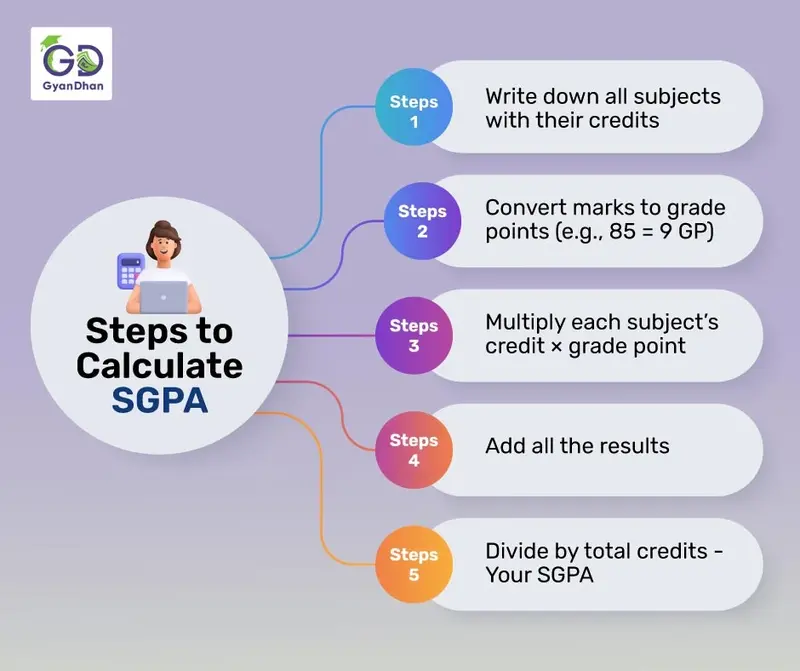
Step 1: List all subjects with marks and credits
| Subject | Marks | Credits |
|---|---|---|
|
A |
85 |
4 |
|
B |
78 |
2 |
|
C |
72 |
3 |
|
D |
65 |
2 |
Step 2: Convert marks to grades using your university's scale
This is where university-specific variations matter. For a standard 10-point UGC scale:
Step 3: Multiply grade points by credits (credit points to SGPA)
Step 4: Add all weighted grade points
36 + 16 + 21 + 12 = 85
Step 5: Divide by total credits
Total credits = 4 + 2 + 3 + 2 = 11
SGPA = 85 ÷ 11 = 7.73
This is how to calculate SGPA from grade points after converting your raw marks. Always verify your university's official marks-to-grade conversion table before calculating.

Before calculating SGPA, you need to understand how grades convert to numerical values. This table is commonly followed across many Indian universities under UGC guidelines and helps ensure accurate grade points to SGPA calculation.
| Grade | Grade Point | Performance |
|---|---|---|
|
O |
10 |
Outstanding |
|
A+ |
9 |
Excellent |
|
A |
8 |
Very Good |
|
B+ |
7 |
Good |
|
B |
6 |
Above Average |
|
C |
5 |
Average |
|
P |
4 |
Pass |
|
F |
0 |
Fail |
Important note: Anna University is famous for its strict Absolute Grading system, where securing an 'O' (10 points) often strictly requires scoring above 90 total marks. VTU and other technical universities may have slightly different thresholds.
Always check your university's official grading policy. The difference can be as much as 8-10 percentage points between universities, which can mean the difference between meeting and missing a cutoff.
Top universities often require you to convert SGPA to percentage for applications. But here's the catch: there is no single universal formula in India, as education is a concurrent subject.
Example: SGPA 8.0 → (8.0 × 10) - 7.5 = 72.5%
Example: SGPA 8.0 → (8.0 - 0.75) × 10 = 72.5%
Example: SGPA 8.0 → 8.0 × 10 = 80%
| SGPA | Percentage |
|---|---|
|
10.0 |
92.5% |
|
9.5 |
87.5% |
|
9.0 |
82.5% |
|
8.5 |
77.5% |
|
8.0 |
72.5% |
|
7.5 |
67.5% |
|
7.0 |
62.5% |
|
6.0 |
52.5% |
Critical mistake to avoid: Using local formulas for international applications. WES/ECE conversions differ from Indian university formulas. When applying abroad, mention both your SGPA and the conversion formula your university uses.
If you already have your percentage and need to estimate SGPA, use this reverse formula:
SGPA = (Percentage ÷ 10) + 0.75
Given: Percentage = 78%
Step 1: Divide by 10
78 ÷ 10 = 7.8
Step 2: Add 0.75
7.8 + 0.75 = 8.55
Result: SGPA = 8.55
This method works as a reverse approach to an SGPA to percentage calculator and is especially useful when institutions require SGPA format instead of percentage.
Note: This is an approximation. Your actual SGPA depends on individual subject grades and credits, not just overall percentage.
Once you know how to calculate SGPA, converting it to CGPA is straightforward.
Formula to convert SGPA to CGPA:
CGPA = (Sum of all semester SGPAs) ÷ (Number of semesters)
You have the following SGPAs:
Calculation:
CGPA = (8.0 + 7.5 + 8.5 + 7.8) ÷ 4
CGPA = 31.8 ÷ 4 = 7.95
This SGPA to CGPA converter method gives you your cumulative performance across all semesters. For study abroad applications, universities often request both your semester-wise SGPA and final CGPA.
Students sometimes need to reverse-engineer SGPA from an overall CGPA, particularly when estimating what grade they need in the current semester to reach a target CGPA.
SGPA = [(CGPA × Total Credits) - Σ(Previous SGPAs × Credits)] ÷ Current Semester Credits
Step 1: Calculate total grade points
8.0 × 40 = 320
Step 2: Calculate previous semester grade points
7.5 × 20 = 150
Step 3: Subtract previous points from total
320 - 150 = 170
Step 4: Divide by current semester credits
SGPA = 170 ÷ 20 = 8.5
This calculation helps you understand what performance you need in the current semester to maintain or improve your CGPA.
Most errors in SGPA calculation happen during execution, not understanding. Here are the mistakes I've seen repeatedly:
Most students Google "SGPA calculation" and follow the first example they find. Then they wonder why their result doesn't match their grade sheet. The example was from a different university with a different scale. Cross-check against your official grade card, every single time.
Solution: Always check your official grade card for the exact grade-to-point conversion your university uses.
Students need to be aware of their institution's credit system, as different schools may use various scales. The most common error is averaging grades instead of applying the weighted method.
Example of the mistake: A student with three subjects (4-credit core, 2-credit elective, 1-credit lab) averages all three grades equally. This ignores that the 4-credit subject should have four times the impact of the 1-credit lab.
Instead, try this: Always multiply each grade point by its credit value before adding them together.
Students should avoid rounding numbers too early in the calculation process, as this can cause significant discrepancies in the final CGPA.
Wrong approach:
Correct approach:
The difference compounds when calculating across multiple subjects.
Technical courses often have 8-10 subjects per semester, including labs and electives. Accidentally skipping one subject even a 1-credit lab distorts your final SGPA.
Solution: Cross-check your calculation against your official grade sheet. Count the total number of subjects and ensure each one is included.
SGPA shows your performance in one semester, while CGPA represents your overall academic performance across all semesters. Students sometimes apply cumulative methods to semester-level data, creating incorrect results.
Solution: Remember that SGPA is for ONE semester only. If you're calculating across multiple semesters, you're calculating CGPA, not SGPA.
Students try to plug raw marks directly into the SGPA formula without first converting them to the university's grade point scale.
Wrong: Using 85, 78, 72 (marks) directly in the formula
Correct: Convert 85→9, 78→8, 72→7 (grade points) first, then calculate
Across India, over 200 universities have adopted the Four-Year Undergraduate Programme (FYUGP) as recommended by NEP 2020. But implementation varies significantly.
A student with a 7.5 CGPA from VTU and a student with a 7.5 CGPA from a central university following the UGC standard have different underlying academic performances, even though their CGPA numbers appear identical.
VTU (Visvesvaraya Technological University):
Anna University:
Mumbai University:
CBSE/UGC Standard Universities:
When applying to universities abroad, SGPA becomes critical in multiple ways:
Despite so many scores being available CGPAs, grades, grade points, averages, percentages, marks a lot of universities also look for your SGPA. This is because your SGPA offers valuable insights into your academic performance.
International universities want to see:
Many universities require WES (World Education Services) or ECE evaluations. These services don't just accept your university's SGPA, they recalculate it using their own methodology.
What changes:
Your 8.2 SGPA might become 7.9 after evaluation, which could affect scholarship eligibility.
Universities often request marks in percentage format. Knowing how to calculate SGPA from marks and convert it accordingly ensures your academic achievements are presented accurately.
One thing I've seen work: When applying abroad, always mention
SGPA isn't just an academic metric, lenders use it to evaluate your loan profile.
Note: A low or inconsistent SGPA doesn't mean automatic rejection. Lenders will assess other factors like:
Check your eligibility: If you're unsure how your SGPA impacts your loan profile, use GyanDhan's loan eligibility tool to get a personalized assessment.
Beyond loans and admissions, SGPA affects multiple aspects of your academic journey:
Under NEP 2020, at the end of the third semester, students are required to choose a disciplinary or interdisciplinary major based on their preferences and their CGPA. Your SGPA in early semesters directly determines which streams you can enter.
Many universities allow branch changes after the first year based on SGPA. A single semester of strong performance can open doors that seemed closed during admissions.
Companies set minimum CGPA cutoffs, but many also check semester-wise SGPA to identify consistent performers. A final-year SGPA of 6.5 can disqualify you even if your overall CGPA is 7.5.
PhD admissions, research assistantships, and academic internships heavily weigh consistent SGPA performance, especially in your major subjects.
Now that you understand how to calculate SGPA and CGPA, keep these critical points in mind:
Different universities use different point scales. Some use 4-point scales, others use 10-point scales. Make sure you're using the right scale for your institution.
Download your university's official academic regulations PDF and verify:
When converting your SGPA for applications, be precise. A 0.2-point error in SGPA creates a 2% error in percentage enough to fail eligibility checks.
Instead, try this: Use GyanDhan's free Grade Converter to accurately calculate SGPA to percentage and CGPA. It accounts for university-specific formulas and reduces manual calculation errors.
Keep semester-wise grade sheets, credit breakdowns, and official conversion certificates. When applying abroad or for jobs, you'll need to prove:
Applying to foreign universities without an official conversion certificate from your college can delay or reject your application.
If a grading system includes failed subjects in the SGPA, these should also be factored into the CGPA calculation. Neglecting to do so can result in an inflated CGPA
Check whether your university:
Calculating your SGPA correctly isn't just about getting a number, it's about understanding your academic standing accurately enough to make informed decisions about study abroad applications, loan eligibility, and career opportunities.
Most online SGPA calculators fail because they can't account for the dozens of university-specific variations in grading scales, conversion formulas, and credit structures. The difference can be as much as 8-10 percentage points between universities, enough to change your entire application outcome.
The key takeaways:
When applying to study abroad, the clarity of your SGPA calculation directly affects how admissions committees and lenders evaluate your profile. Getting it wrong can cost you scholarship opportunities, loan approvals, or even admission offers.
If you're planning to study abroad and need help understanding how your SGPA affects your education loan eligibility, connect with GyanDhan's experts and book a free consultation. We've helped thousands of students navigate academic evaluation complexities and secure funding for their education goals.

SGPA full form is Semester Grade Point Average. It measures your academic performance for a single semester only.
An SGPA between 8.0-9.0 is generally considered good, but context matters more than the number. Based on GyanDhan's analysis of 15,000+ loan applications, here's what actually happens at different SGPA levels:
One VTU student with 8.2 SGPA got into Georgia Tech with partial scholarship, while another with 8.8 SGPA from a tier-3 college struggled with admissions because of university reputation. Your SGPA matters, but so does where it came from.
SGPA measures one semester; CGPA measures your entire program. But here's what most students miss: lenders and universities care about the SGPA trend, not just the final CGPA.
Example: Two students both have 8.0 CGPA.
Student A: 7.5 → 7.8 → 8.0 → 8.2 → 8.5 (upward trend)
Student B: 8.5 → 8.0 → 8.0 → 7.5 → 8.0 (declining trend)
When we analyzed loan applications at GyanDhan, Student A profiles got approved 40% faster because lenders see upward trends as lower risk. Universities interpret it the same way, improvement signals adaptability. Your semester-wise SGPA tells a story. Make sure it's the right one.
The SGPA calculation formula is:
SGPA = (Sum of [Credit × Grade Point] for all subjects) ÷ (Total Credits)
Always multiply grade points by credits before adding them, don't just average the grade points.
If you fail a subject, it's typically assigned 0 grade points. However, the credits of that subject are still included in the total credits. This directly lowers your SGPA because the formula considers both grade points and total credits.
Example:
SGPA = (36 + 24 + 0) ÷ (4 + 3 + 3) = 60 ÷ 10 = 6.0
The failed subject significantly reduces your overall SGPA even if you performed well in other subjects.
No. If your institution provides an official calculator, use only that for SGPA conversions. Generic calculators assume standard UGC grading, which may not match your university's specific scale.
Always verify calculator results against your official grade sheet.
Failing a subject drops your SGPA significantly because the failed subject gets 0 grade points but its credits still count in the formula. A single 3-credit fail can drop your SGPA by 0.5-0.8 points depending on your other grades.
Example:
Before fail: 8.2 SGPA
After one 3-credit fail: 7.4 SGPA
Impact on loans: Most lenders require 7.0+ SGPA for unsecured loans. One fail can push you below that threshold. However, lenders look at:
If you have an active backlog when applying for loans, disclose it upfront. Lenders prefer honesty over discovering it during document verification. Clear all backlogs before submitting your loan application for best approval chances.
Check Your Education Loan Eligibility

Ask from a community of 10K+ peers, alumni and experts
Be the first to discuss this article
Ask a question or share your experience with students on GD Connect.
Add Your ResponseTrending Blogs
Similar Blogs

Network with a community of curious students, just like you
Join our community to make connections, find answers and future roommates..Country-Wise Loans
Best Lenders for Education Loan

ICICI Bank

Axis Bank

Union Bank

Prodigy

Auxilo

Credila

IDFC

InCred

MPower

Avanse

SBI

BOB

Poonawalla

Saraswat