




.webp)










Help our experts understand you better by filling our 2-Minute Form, to find the right education loan
Get instant loan offer suitable to your profile !

On this Page:
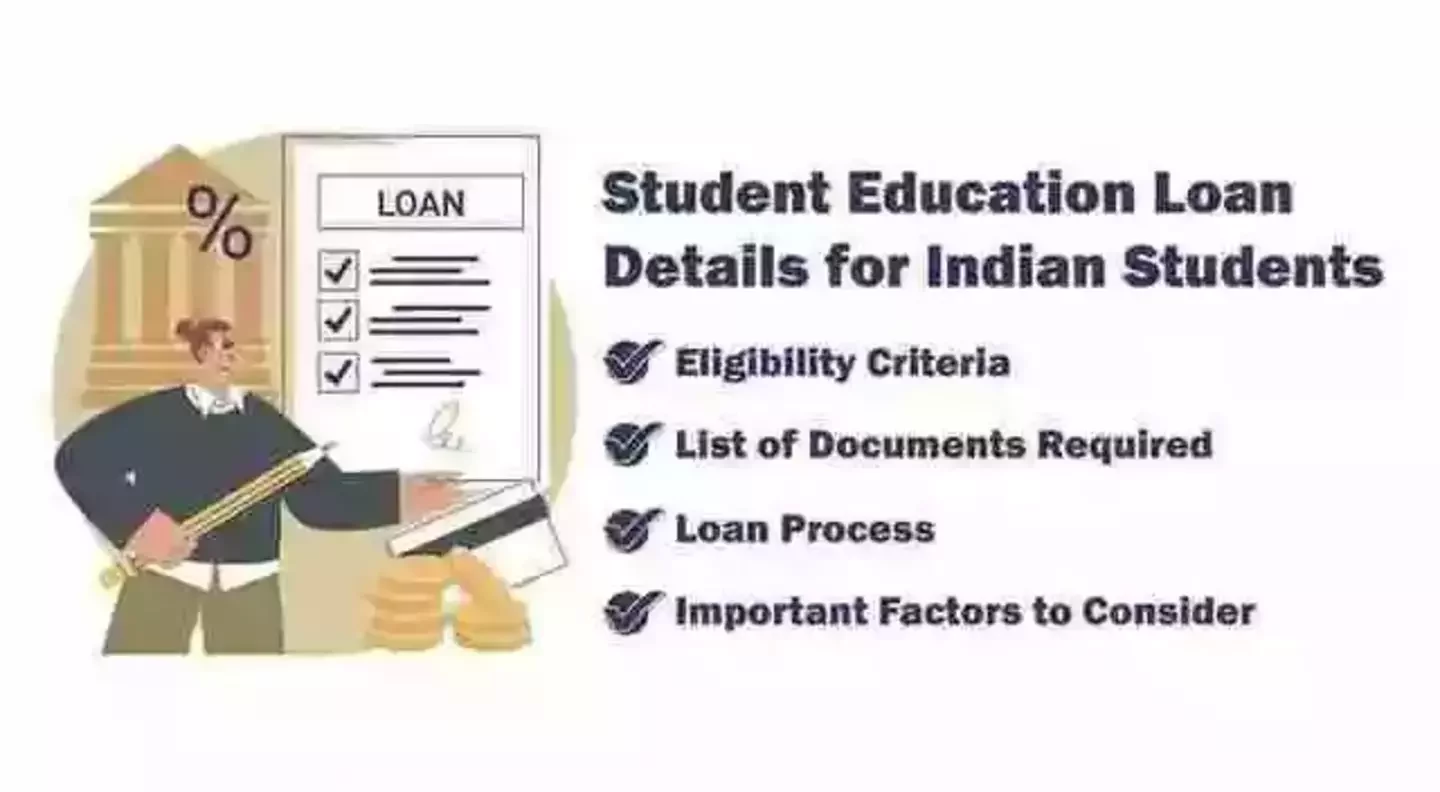
Know all the details about student education loans for Indian students. Understand the eligibility criteria, list of documents required, loan process, and more.


India’s students have always been known for their hard work, but in contemporary times, it’s not the hard work alone that will sail you through your entire education. You need to know everything about education loans to get admission to your dream university without worrying about your finances. At present, you can’t afford to be unaware of how education loans work in India at some point in time, and you have to get one, especially if you are eyeing an overseas education. It is always advised to plan by knowing all education loan details and making an informed choice when the need arises. So, let’s cover all the details so that you don’t have to worry about how a student loan works in India and you can at least have a roadmap in your mind.
Check Your Education Loan Eligibility

The first and foremost thing a student should know about the student loan process is the eligibility criteria. Not everyone is eligible for all types of loans. It will help you to understand the type of loan you need and thus plan accordingly.
Here, we are providing you with a broad set of criteria that you will find with almost all the lenders, and they are as follows:
 The age limit for education loans in India is 18 years; if it is less than that, the parents will have to take the loan.
The applicant must be an Indian citizen.
The applicant must have a valid Indian passport (for overseas education loans).
The applicant must show the acceptance letter to a recognized university. In the case of a university abroad, it must be on the list of universities of the concerned lender.
The course for which you have applied must be on the list of the banks. Banks don’t lend for all the courses, so you must check the list of eligible courses.
Banks will also assess your academic track record and the marks you have secured in tests like GRE, GMAT, IELTS, TOEFL, etc.
The age limit for education loans in India is 18 years; if it is less than that, the parents will have to take the loan.
The applicant must be an Indian citizen.
The applicant must have a valid Indian passport (for overseas education loans).
The applicant must show the acceptance letter to a recognized university. In the case of a university abroad, it must be on the list of universities of the concerned lender.
The course for which you have applied must be on the list of the banks. Banks don’t lend for all the courses, so you must check the list of eligible courses.
Banks will also assess your academic track record and the marks you have secured in tests like GRE, GMAT, IELTS, TOEFL, etc.
This is the broad set of criteria, but there will be lender-specific criteria too. So, you must check them thoroughly before deciding to move ahead with a particular lender.
The education loan process in India involves a broad set of documents you must have to convince lenders of your capacity to repay the loan. You must submit a comprehensive set of academic, financial, and legal documents. However, this documentation process is easy for some finance companies working in this space, who’d collect all your documents from home and help you get the best loan. The education loan rules change from one lender to another, but the list of documents remains the same to a large extent, barring some minor changes.
A duly filled and signed application form with all the signatures of the loan applicant, the co-applicants, or any third party.
Colored photographs of the loan applicant should be clear.
The proof of residence of the loan applicant and the co-applicant or a third party.
A valid photo ID card of the applicant and co-applicant It could be a driving license, an Aadhar Card, a passport, a PAN Card, a voter ID card, or any other valid ID.
The letter of acceptance or any other proof of admission from a recognized university abroad or in India.
The bank statement for the last six months of the co-applicants
The income proof of the co-applicant and the IT return of the last six months (if applicable)
In the case of a secured loan, the details of the property viz.
Property title documents.
NOC from the developer.
property tax receipts.
The documents related to your academics, e.g., mark sheets, passing certificates, degree certificates, IELTS/TOEFL/GRE/GMAT scores, or any other document that the lender might ask for.
To know more about Documents Required for Education Loan, click here.
Calculate your Education Loan EMI
There are two types of loans: one that needs collateral and the other that doesn’t. So, as a student, you need to know about both of them. The type of loan depends on your financial capability, and it’s important to understand this before we delve into other aspects of the education loan process.
These are loans wherein you have to pledge collateral, and the amount of the loan will be decided on the value of your asset. You can use your land (non-agricultural), flat, or house. But these sorts of assets are relatively less liquid, and the quantum of loan is up to 75% of the value of the asset. You can also pledge other assets that have relatively more liquidity than others, e.g., gold, bonds, fixed deposits, etc., as these assets can increase the quantum of loan up to 90% of the value of the asset. PSBs, private banks, and NBFCs all give this type of loan.
To know more about Types of Collateral Security Acceptable for an Education Loan, click here.
For those meritorious students who don’t have collateral to pledge, lenders provide them with the option of unsecured loans. You will not have to pledge collateral for this type of loan. However, there are a few things that you must know. The rate of interest is high on these loans, and the quantum of loans is also less. Public sector banks don’t give unsecured loans. Only private banks and NBFCs give unsecured loans.
The process of education loans in India varies from one bank to another, but largely, the process remains the same. The process involves the following steps:
Get an estimate of the education loan amount you wish to take, including the tuition fee, the cost of living, and any other miscellaneous expenses.
Check with your lender if they are willing to give you a loan for the university where you are planning to get admission.
Do a comparative analysis with all the lenders that are willing to lend you an education loan. Apply as soon as possible since the entire process might take anywhere between a week to a month, depending on the lenders.
Once you are done with these steps, start by filling out the application form.
Collect all the documents, and ensure there aren’t any discrepancies at this point.
Get the loan documents once the loan is approved.
Then you will have to sign the loan document finally, and then the bank will disburse the loan amount.
Read Also:
Loan Repayment: Education loan repayment rules in India vary from one lender to another. The loan repayment duration for public sector banks is 10 to 15 years. While in the case of private banks, it is usually 15-20 years, while for NBFCs, it is usually 10 years.
Choosing a Lender: The next important question that might be bothering you is how to get an education loan easily. Well, this is where the lender’s role comes into play. Private banks and NBFCs process the loan very fast, and if all the documents are right, then you will be able to get the loan within a fortnight. However, if you choose a PSB, then it might go up to 3 weeks. But PSBs offer loans at a lower interest rate and better repayment terms. So, you must choose the lender who gives you the maximum benefits, and this varies from one borrower to another.
Loan Amount: Another question that comes to a borrower’s mind is how much student loan can I get in India? It is a subjective question; it entirely depends on your needs, academic record, the university where you are going, financial capacity, and the lender you choose. For instance, PSBs readily lend up to INR 1.5 Cr, and private banks also lend close to PSBs depending on your needs. But when it comes to NBFCs, there is no limit, and they are more into need-based lending.
Moratorium Period: The moratorium period, or repayment holiday, is the time after the completion of your course during which you don’t have to start the repayment. PSBs and private banks give a moratorium period of six months to one-year post completion of the course, while NBFCs usually provide a moratorium of six months.
Interest rates are low in PSBs when compared to NBFCs and private banks. NBFCs charge the highest interest rate, which can go as high as 15%, while in PSBs, it is usually charged between 8.5% and 10%. In private sector banks, the rate of interest is from 11% to 12.5%.
A decade back, getting an abroad education loan was a big deal for students, but with the advent of Private Banks and NBFCs, the borrowing process has become smooth. Now you can easily approach finance companies working in this space which would help you from collecting your document to getting you a forex card. They also help students in getting affordable loans by negotiating the terms of repayment to interest rates. So, if you plan to go abroad, start searching for the process immediately.
Check Your Education Loan Eligibility

Ask from a community of 10K+ peers, alumni and experts
Be the first to discuss this article
Ask a question or share your experience with students on GD Connect.
Add Your ResponseTrending Blogs
Similar Blogs

Network with a community of curious students, just like you
Join our community to make connections, find answers and future roommates..Country-Wise Loans
Best Lenders for Education Loan

ICICI Bank

Axis Bank

Union Bank

Prodigy

Auxilo

Credila

IDFC

InCred

MPower

Avanse

SBI

BOB
Poonawalla
Saraswat